Showing posts with label Women. Show all posts

Saturday, October 12, 2013

Yemen’s Quota: Success for International Community or Yemeni Women?

This article was originally published through Fikra Forum on Sept. 27, 2013

On September 15, Yemeni President Abdu Rabu Mansour Hadi wrote his first-ever op-ed in hopes of reassuring the Yemeni people of the current political transition’s progress. The article, published in Yemen Times and available only in English, highlights the role of women during the transition and praises the status of women in Yemen. More importantly, the President indirectly endorses the proposed 30% quota; he writes, “To ensure these voices are heard, a new coalition of influential women held a press conference today advocating for national support for at least, a 30 percent quota for female [representation] in all branches of government.”

Without a doubt, women’s participation in the National Dialogue Conference (NDC) has been powerful, with women representing almost 28% of all participants. Female representatives chaired three of the nine working committees. They also formed alliances within and outside the dialogue to champion women’s rights; yet in spite of these efforts, they could not reach a unanimous decision regarding the 30% quota. Regardless, it appears that Yemen’s NDC will pass the 30% quota for women in all three branches of the government, but is this success due to the persistent efforts of Yemeni women, or is it in order to make Yemen look more democratic?

While the participation of women in the NDC is impressive, the dialogue remains completely detached from the realities of Yemeni women on the ground. The transitional process, which was meant to conclude on September 18, continues to be strongly supported by the international community. This begs the question of how successful the process is likely to be in the long term if its goals are achieving international approval as opposed to true engagement and impact on the ground.

The 30% Quota 

According to the NDC process requirements, at the initial stage, an article must receive 90% of the vote among the committees in order to pass; otherwise it is sent to the Consensus Committee, which was established to oversee the dialogue process in order to maintain harmony. If the Consensus Committee modifies the article and sends it back to the committees, it must then receive 75% approval or it is returned again to the overseeing body. Finally, a modified draft must be passed by 55% of the committees. If it is not passed by the committees, the Consensus Committee and the dialogue president make the final decision on whether or not to move forward with the article.

The State Building, Good Governance, and Rights and Freedoms committees in the NDC all convened to discuss the women’s quota, which, if passed, would require 30% of officials to be women across all branches of government. The State Building Committee was the only committee that managed to pass the initial required 90% consensus, though this was only due to the fact that some members withheld their vote on the assumption that it would lower the consensus rate. The other two committees did not reach the required votes so, according to dialogue procedures, the matter was transferred to the Consensus Committee before August. At that time, it was reasonable to assume that the subject would be transferred back to the working committees where women would have to form alliances and work hard to get the required 75% consensus to pass the article.

If the women and the youth groups were to unite their votes to win consensus in the committees, they would still likely fall short with only 50%. From there, it would be extremely challenging to gain the remaining required votes, especially considering that several men who publicly endorsed the 30% quota later rejected it when it was time to vote. The traditional powers in Yemen publicly opposed the idea of a 30% quota, and even the “liberal” parties of Yemen opted for a 15% quota rather than the proposed 30%. However, after the president’s op-ed, several party members in the dialogue shifted their tone. The Consensus Committee then agreed that women should be represented in all three bodies of the government, thereby postponing the discussion of a women’s quota until the final plenary session.

Assessing the Quota

The women’s quota is based on the idea that it will improve women’s participation in governance, thus advancing women’s issues, through a top-down approach. First, this is based on the assumption that the creation of a 30% quota for women ensures that it will be implemented, when in reality, there are no guarantees that this will occur. Then, there is the assumption that the women selected or elected will put women’s rights ahead of their party’s political agenda. The real question is whether or not this quota can truly make a difference in transforming the deteriorating conditions of women’s health, illiteracy rates, unemployment, and economic status. It certainly can, but only if women politicians and government employees work hard for these rights.

Several men argue that women are not ready to have the 30% quota because too few women are qualified, either based on education or professional experience. This argument, however, is invalid. Many male officials are placed in their positions for their social connections rather than their qualifications. Another argument is that 30% is too high a quota, especially since men are the main providers for their families. This argument is also weak because figures have shown that women who make more money spend their wealth on their families. Furthermore, if Yemen embraces federalism, new local governments will lead to new positions and jobs so women will not “steal” any of the available jobs.

There are two main legitimate concerns regarding the quota: first, that the quota will not be implemented; and second, that the women selected through the quota will promote their party’s agenda rather than a women’s agenda. In either case, it is possible that the 30% quota is setting Yemeni women up to fail, but it is a risk that Yemen’s women should be willing to take.

Yemeni women have worked very hard since the early 1990s for every right that they have. If the quota is passed, then women should use it to their advantage as an opportunity to continue their good work of improving the status of women in society. The quota for women is not the only solution, but rather one of the many ways in which women can influence politics. Unfortunately, Yemeni women were seen as symbols of democratic change in the 2011 Yemeni uprising, but they have not so readily been approached as serious influencers of the political process. If the women’s quota is viewed by the international community and the Yemeni government as a primary benchmark of “success” of the current political transition without a serious commitment to supporting its implementation, the quota, like the dialogue, will merely be a process involving the upper echelons of society and will have no real impact on the reality on the ground.

Sama’a Al-Hamdani is a Yemeni researcher and writes on the blog Yemeniaty.com. You can follow her on Twitter @Yemeniaty. 

Wednesday, April 3, 2013

Female Agency in the Yemeni Transition


This is published in the International Training Programme for Conflict Management (ITPCM) and can be found online here.


For the first time since unity in 1990, Yemeni women are challenging tradition. Breaking curfews, participating in political activities after nightfall, reciting folkloric poetry and shouting revolutionary slogans became common during and after the Revolution. For women, the Revolution was truly exceptional. They participated in sit-ins and addressed mixed crowds. The decoration of Nobel Peace Prize Laureate Tawakkul Karman underscored the activism of Yemeni women around the world. Yemeni women were featured in numerous magazines, websites and newspapers as champions of civil society. During the uprising, women were equally as influential as men. In essence, women initiated a revolution within a revolution. The presence of Arab women in the public sphere during the Arab Spring misled many observers to believe that a women’s right movement was underway. Others were skeptical, warning that once political regimes began to collapse, the status quo would be restored. Only a few bothered to ask: what do women want from their Revolution? Yemeni women cannot uniformly answer this question because their experiences are not monolithic. The political dichotomy of the North and South produced alternate realities for women, especially as the North is more conservative and tribal than the South. After the unity in 1990, these realities continued to change based on the location, affluence and heritage of a woman’s family. Coupled with Yemen’s patriarchal and conservative culture, it was difficult to establish a unanimous movement for women. The current transitional government has three women Ministers out of 35. The Technical Preparatory Committee (TPC)[1] for the National Dialogue was composed of 19% women. One female out of 301 members is a parliamentarian and two women are members of the Shura Council. These political positions, none of which are decision-making, give the impression that women in Yemen have a greater role in the executive branch. The term “feminism” in itself remains controversial, and gender issues must be handled with care. In a system that is discriminatory in its legislation[2] against women, “feminist” objectives can be sidelined. Since women’s freedoms were restricted after Saleh’s fall, it became apparent that some of the women who participated in the uprisings were merely pawns for opposition parties. Despite these setbacks, there have been minor improvements to women’s political participation. On March 18, the National Dialogue began, leaving the fate of Yemen’s entire female population in the hands of a few women from various political backgrounds. Their goal is to simultaneously advocate on behalf of their parties and organizations, as well as women more broadly. As of now, existing accommodations made for women are insufficient, making it difficult for the National Dialogue to facilitate gender equality. Women must lobby for their rights outside of politics, and approach the problem from a different perspective to see results. As Feminists or as Politicians at the National Dialogue?
Current president, Abd Rabbuh Mansour Hadi, made a point of advocating a 30% female quota in the National Dialogue. The conference will separate members into nine working committees.[3] Members have submitted their committee choice to the President[4] of the dialogue and his six deputies, none of which are women. Soon, these committees will begin their deliberations. Even though women’s issues deserve broader representation across the board, the topic will be examined under the eighth committee, “Rights and Freedoms”. Constitutional reform will be discussed in a separate committee, “Good Governance”. The structure of the dialogue does not support wholesale changes to the status of women’s rights, and it is not evident that discussion of women’s issues will make it into questions concerning constitutional reform. The status of women and their inability to affect change through the Dialogue are exacerbated by two problems. First, some of the women selected to participate are at a crossroads: are they feminists or politicians first? Are they representatives of their party or of women? Yemen’s “democratic” transition has played out as an exclusively political process through which women are incentivized to champion ideas that oppress other women. Unified by gender but divided by politics, women in the National Dialogue will frame gender issues like women’s security, economic poverty and illiteracy as political issues. Based on political divisions, the methodology of dealing with these topics will vary. Religious parties like Islah, Ansar Allah (Zaydi), Al-Haq (Zaydi and Hanafi) and Al-Rashad (Salafi) would approach women’s issues from a Shar’iah perspective, but ideological differences are likely to cause disagreements. Socialist groups, independents and even Ba’thist will advocate non-religious reforms or a mixture of both. A single group of unified women is much more powerful than smaller groups of women that are at odds. These political issues will polarize the women’s agenda and make it susceptible to the principle of divide and rule. Second, the same tactics used to question the legitimacy of the dialogue can be used to challenge solutions proposed to promote women’s rights. Any “feminist” agenda could be quickly dismissed as part of a Western conspiracy, since the dialogue itself is viewed as a foreign initiative rather than the result of a grassroots national process. Like several Arab Spring nations, Yemen is witnessing a rise in Islamic fundamentalism. Four religious parties will participate in the dialogue, and since Islah gained more influence beginning in 1994, female judges were dismissed as “incompetent in Islamic Law” and public schools were gender segregated after the sixth grade.[5] A narrow implementation of Islamic Shari’ah is expected. In Yemen, female equality is argued as a social liberalization process antithetical to religion, which could guarantee its failure. In Yemen’s conservative culture, religion dominates politics. The prevalence of early marriages in Yemen provides a revealing case. When Islah gained influence in Saleh’s government, the marriage age of 15 was abolished[6]. Since 2007, several governmental and non-governmental campaigns were launched in hopes of mandating a marriage age, but none of them succeeded. Radical interpretations of Islam were used to manipulate and limit the scope of female self-determination. The problem of child marriages still persists. According to Amal Basha, the spokesperson of the TPC, it has been a struggle to add the issue of underage marriage to the agenda of the National Dialogue. Eventually, TPC members “unanimously agreed to give it social priority.” Addressing child marriages, again, as a social issue with the same political actors makes it hard to fathom how social transformation can emerge through the National Dialogue. If previous methods proved futile, Yemeni women need to seek alternatives. Gender Strategies Outside the Social Realm
To improve women’s conditions, women need to frame their arguments outside of politics. A strategy that separates women’s issues from traditional values could prove successful in Yemen. Currently, 54% of Yemeni women are married before they reach the age of 18.[7] By tackling the “side effects” of child marriages, Yemenis can limit its social prominence without causing an overwhelming social backlash. About 58% of Yemeni women are illiterate.[8] Educational policies put in place by the government can assure that more girls are going to school. In Yemen, marriage means being a full-time homemaker, and if more girls are going to school, then they are less likely to marry or having children at a young age. Other strategies can tackle the same problem. Innovative health policies can produce substantial changes in reducing the high maternal and infant mortality rates.[9] Poverty alleviation programs are another method through which women can lobby for reform. Since 44% of the Yemeni population is acutely malnourished[10], financial incentives can promote the use of contraceptives[11] to control population growth and address food scarcity. It is unlikely that women’s issues will receive special attention, since Hadi’s administration has been preoccupied with more pressing issues like security and military reforms. With soaring inflation and an unemployment rate at 42.5%[12], the nation is facing several challenges. Therefore, women need to address their needs by mobilizing collectively. Between Sa’dah’s six wars and Al-Qaeda’s occupation of Abyan, 50% of Yemen’s Internally Displaced Persons (IDPs) are between 5-17 years old[13]. Only a quarter of IDPs from all age groups return to their homes[14]. These challenges impose damage on the female body. Displacement can also lead to rape, gender violence, human trafficking, and prostitution. Women as a group need to realize that protecting their gender is feasible through security programs. Another collective concern is the deteriorating economy. In March, Friends of Yemen pledged around 7.5 billion dollars[15] in assistance to Yemen. While the majority of the money is allocated to development programs, the government must assign a portion of it to specifically empower female entrepreneurship Without change, the nation will continue to be the lowest ranked country in the world in gender equality. Increasing female participation in the labour market can decrease harmful social traditions. Using women as agents of economic reform can result in the creation of a new workforce that facilitates the self-determination of women. Conclusions
The national dialogue promoted the inclusion of women in the transitional process, but this inclusion does not guarantee a transformation of reality in Yemen. Previous tactics, like addressing women’s issues as social concerns, could lead to political manipulation. Also, these measures have been proven ineffective. The dialogue is still in its infancy. Until a clearer picture of the Dialogue’s trajectory emerges, women will not be able to formulate a viable strategy. The National Dialogue is attempting to address numerous concerns at once, while struggling to maintain unity and reform a corrupt political system. For the time being, women need to advocate through each of the nine working committees. The female members of the dialogue are responsible for tackling women’s issues strategically from every possible front, because the obstacles facing them are not independent of each other, but are closely related and must be treated as such. To restrict the harmful consequences of tradition, non-social solutions should be considered. For instance, increasing female participation in educational programs, health programs and in workforce can alleviate problems such as child marriage. If more girls are going to schools then less of them are available for marriage. Affordable and accessible health care can reduce early deaths amongst young mothers and infants. Economic opportunities for women can provide families with additional income. While it is challenging to demand equality in a conservative culture, it is reasonable to demand equal access to health, education and economic opportunities. For the full emancipation of women, Yemen’s constitution must clearly delineate women’s rights, otherwise laws will continue to sanction the oppression of women. Women in the dialogue need new methods and must remain cautious of political ploys. Gender equality is difficult to achieve, but it will only become possible once we are aware of alternative options.


________________ [1] A 31-member Committee commissioned by President Hadi to decide on the size of participants, the rules for eligibility and for the mechanisms used during the dialogue. [2] Laws do not dictate but rather permit discrimination. For example, the Personal Status Law on wife’s obedience sanctions marital rape and restricts women’s freedom of movement. [3] Committees are divided based on Issues: Southern Issue, Sa’dah Issue, National Issues, State-building, Good Governance, Military & Security building, Independent Agencies, Rights & Freedoms, and Comprehensive Development. [4] President of the Dialogue is President Hadi. [5] Molyneux, Maxine, “Women’s Rights and Political Contingency: The Case of Yemen, 1990-1994.” Middle East Journal 49.3 (1995): 418-31. [6] Khalife, Nadya, How Come You Allow Little Girls to Get Married?: Child Marriages in Yemen. New York, NY: Human Rights Watch, 2011. [7] “Yemen: A Wake Up Call to Early Marriage.” Oxfam International Blogs. Oxfam, 30 August 2012, retrieved on-line 15 March 2013. [8] According to World Bank Indicators, 2010. [9] “Yemen: A Wake Up Call to Early Marriage.” Oxfam International Blogs. Oxfam, 30 August 2012, retrieved on-line 15 March 2013. [10] Burki, Talha, “Yemen’s Hunger Crisis.” The Lancet 380.9842 (2012): 637-38. [11] Only 9.3% of Yemen’s population uses a modern form of contraception. USAID Country Health Statistical Report, Rep. Washington DC: Bureau of Global Health, 2009. [12] The Second National Millenium Development Goals Report. Sana’a: United Nations Development Fund and the Republic of Yemen, 2010. [13] The Republic of Yemen. Operational Unit for IDPs Camps. Information Center.Summary Showing the Number of Households by the Orginal District and Governorates. Sana’a: ROY, 2013. [14] Ibid. [15] Andersen, Inger. “Friends of Yemen: World Bank Vice President Inger Andersen Urges Support for Yemen’s Transition.” Friends of Yemen: World Bank Vice President Inger Andersen Urges Support for Yemen’s Transition, The World Bank, 7 March 2013 retrieved on-line 14 March 2013.

Saturday, March 30, 2013

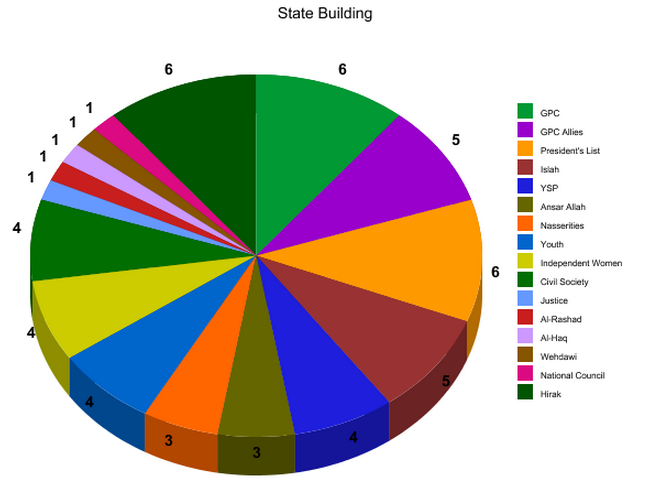
Yemen's National Dialogue Working Committee: Visual Learners Edition

(Reproduction of the following charts is permitted as long as they sourced to Yemeniaty)

On March 30th, Yemen's National Dialogue website released the names of the members participating in the nine working groups. The nine working committees will discuss the following topics: 

1) Southern Issue 
2) Sa'dah Issue 
3) Good Governance 
4) State building 
5) National Reconciliation
6) Development
7) Rights and Freedoms 
8) Army and Security  
9) Independent/Social Issues

Although it seems like the final list will need revisions since several lists appeared online and were circulated amongst Yemenis with different numbers of participants. So far 11 members withdrew from the dialogue: 

- One independent: Ahmed Saif Hashed 
- Three from Islah: (1) Mohsin Ba'Sorah, (2) Tawakkol Karman and (3)Sheikh Hameed Al Ahmar 
- Seven from Hirak: (1) Ismahan Al-'Alas,  (2) Saleh Taher Al-Isa'ey, (3) Abdulaziz Abdul Hameed Al Maflihi, (4) Sheikh Tarek Al Mohami, (5) Mahmoud Shaief Hussein, (6) Mustafa Zain Al-'Aidaroos and (7) Khaled Ba-Ras. 


The total number of participant should be 554; however, after several revisions to different lists the following charts are based on a 555 member conference. 

Here are the groups: 


In this committee, Hirak members have the biggest share. Followed by GPC, then YSP and Islah. 

This category is dominated by GPC, then Hirak then members from the President's list. This category is where child marriages and other women issues will be discussed and it has 36 women and 45 men. 

This is another group where Hirak, GPC and the members from the President's list have the most representation. 

Civil Society is represented better in this category than most of the other working Committees. 


Like the Southern Issue Committee, this group is represented by people who are affected most by it: Ansar Allah (formerly referred to as Al-Houthis). However in comparison, they are less represented since the committee is composed of 48 members (Southern Issue 40) and only 10 are from Ansar Allah. Also, Hirak has equal members to the GPC (6 seats), while Ansar Allah had only 2 seats in the Southern Issues Committee. 

This group will be looking at constitutional reform. Half of the members in this group are from Civil Society, GPC, GPC's Allies, Islah and the President's list. Possibly the least group with Hirak representation. 
The Army and Security is a surprisingly fair to the South in that Hirak has as many seats as GPC. Unfortunately this balanced is tipped off when GPC gave its allies 5 seats. The real losers in this category are women (4/45)
The main topic in the Good Governance Committee is Civil service reform. It seems to be a fair representation of the members chosen for the dialoge. 

Like expected, women are represented fairly in the development, independent/social issues, human rights and freedom, and national reconciliation group. Women are less likely to be present in serious issues like security and military, Southern and Sa'dah Issue. 


The final list of members in the Southern Issue is challenged by the Southern Hirak and the final list will be issued tomorrow. All these representations are susceptible to change.   

Thursday, March 7, 2013

Pictures from My Country: Women's Day Edition

Today, in honor of women's day, I share photographs of Yemeni women. Also, I want to point out that a women's march is taking place in Sana'a in support of peace. Sarah Jamal (who organized the march) writes: 
We are the civil peace makers and we the ones who protected it throughout Yemen's history .. Yemen only flourished during our reign and only knew of resolutions to tribal conflicts through us... On Women's International Day, in Yemen we [the women] lead the demand to civil peace without sectarian or regional conflicts... Let Yemen's women lead its peace...
Today, rather than looking at women as the inferior sex, we celebrate Yemeni women as queens. 

Photography by Abdulrahman Jaber 


Thursday, January 24, 2013

Yemen’s National Dialogue: The Country’s Critical Test for Stability

My latest piece published on Fikra Forum, January 17, 2013. 

On November 23, 2011, Yemen’s revolution subsided with an agreement brokered by the Gulf Cooperation Council (GCC), enacting a two-year transitional government led by President Abdu Rabu Mansour Hadi. According to this agreement, a national dialogue is scheduled to take place by the end of February or the beginning of March to decide the formation of the new government and its constitution. However, the transition appears to be dawdling, causing many Yemenis to lose faith. Delays can be attributed to Yemen’s complex ethnic and tribal affiliations and interests, a deteriorating security situation, and Hadi's meticulous oversight, with a careful intent to avoid aggressive backlash and to maintain the nation's stability. Nevertheless, the national dialogue is progressing, the success of which will be critical in determining the future stability of the country.

Planning the National Dialogue

In July 2012, a technical committee was chosen to determine the overall nature and logistics of the dialogue. From August to December 2012, the technical committee, led by Yemen’s former Prime Minister, Dr. Abdulkarim al-Eryani, held 65 meetings, each followed by a press release and updates to the official Facebook page. The committee concluded its meetings with a report that was presented to President Hadi.

As a result of the technical committee’s report, the dialogue will have a total of 565 members. Around 40% of these seats are designated to political parties (not including new parties), while 35 seats are dedicated to Houthis, and 85 to Hirak Southern Separatist Movement members. The political parties must select their delegates according to the following stipulations: 50% of their seats must be assigned to people from the South of Yemen, 30% to women, and 23% to the youth. Furthermore, 160 seats are allocated to non-partisan groups: 40 for independent youth, 40 for independent women, and 80 for civil society organizations (2 members from each organization). Each category will be selected by seven technical committee members. The deadline for non-partisan applications is January 19. Overall, the aim of the committee is to host a dialogue that will be equally divided between Northern and Southern Yemenis.

Complicating matters further, the final list of the national dialogue attendees must include Yemen's tribal leaders, jurists, religious minorities, businessmen and women, young or new political parties, and those with special needs. The selection process for these groups remains unclear, though President Hadi has the right to nominate these individuals or create a special committee that will select them.

The moderator of the dialogue is still undecided, but two options are available. Either the president and the technical committee will appoint a person, or the national dialogue members will recommend individuals and vote. The national dialogue will most likely be held in Sana, however, the technical committee agreed that if security permits, other meetings should be held in Aden. Working teams will also operate in the following cities: Aden, Taizz, al-Mukalla, Sadah, and al-Hudaydah.

The national dialogue budget is 7.7 billion rials, none of which is provided by the Yemeni government. The technical committee’s report concludes that a portion of the budget will provide transportation, housing, and food during the expected dialogue period of six months. Finally, a special television channel and radio will be dedicated to broadcasting all of the national dialogue events. While the money has been pledged to Yemen by GCC countries, it has yet to be received, revealing the GCC’s lack of confidence in Yemen’s decision-making.

What to expect

A recent meeting on January 14 between President Hadi and those involved in the transitional phase (the national dialogue technical committee, political figures, and ten foreign ambassadors) is revealing as to the intricacy of Yemen’s current situation. Though the dialogue is supposedly “national,” international agencies and actors are heavily involved in supervision. The Houthi representative, Mohammed al-Bukhaiti, refused to attend the meeting because the U.S. Ambassador was present. This is an indicator of what could happen during the dialogue if international actors attempt to partake rather than observe.

All Yemenis, regardless of their political opinions, must be represented in this dialogue; otherwise, the dialogue will fail and the country will be paralyzed. So far, the Southern Hirak has not released their party list and independent applicants from the South are hesitant to apply, seemingly discouraged to join. Recently, in a first step toward transitional and restorative justice, Hadi assigned two committees to address land disputes and forcible job expulsions that occurred in Yemen’s southern provinces of following the 1994 civil war. If this effort fails, the southerners will continue to feel persecuted and will demand secession.

The deteriorating security condition in Yemen makes it nearly impossible for the national dialogue to operate in various cities. Even in Sana, there are major security concerns. On December 22, 2012, three westerners were kidnapped in the heart of Sana and have yet to be released. Earlier this week, an AQAP cell was discovered in the capital. Aware of these security challenges, the technical committee, now called the preparatory committee, has dedicated a portion of the national dialogue budget toward special security.

Other important issues relating to security remain unanswered. Currently, a committee has been tasked with restructuring Yemen's Ministry of Interior. The goal is to mimic the structure of Jordan's Ministry of Interior, but the transformation will not be easy. In the next month, President Hadi is expected to announce the names of the commanders assigned to the seven armed forces that were newly reformed through his December 19 decree calling for the restructuring of the military. As long as this effort remains unrealized, security will be a constant threat to Yemen's successful transition.

Following President Hadi’s decree, many wonder what will happen to Ali Mohsen al-Ahmar, former leader of the First Armored Division. Mohsen, though demoted, remains an influential military figure, and may participate as an advisor to the tribal members of the dialogue. Meanwhile, former president Ali Abdullah Saleh is still considered the president of the General People’s Congress (GPC) party, though he is sick and needs medical treatment. The national dialogue technical committee did not specify any restrictions against Saleh’s attendance, but if Saleh decides to attend, the majority of participants will withdraw, ruining any real chance of dialogue.

The remaining influential figures worth noting are Hamid al-Ahmar, a businessman and leader of the Islah party, and Abdulkader Hilal, mayor of Sana. Al-Ahmar is a powerful man, with many loyalties among the Salafis, and even jihadis. He will likely attend the dialogue and he might even run for presidency int 2014. Hilal has also been rumored to be a presidential candidate. Like Mohsen and Saleh, he is from Sanhan, and he is a military man. On December 12, 2012, he successfully led a clean up campaign called “Sharik” to fix Sana’s streets, winning him much public acclaim.

The role of the U.S.

The U.S. government’s policy toward Yemen has been primarily concerned with counterterrorism. The American Ambassador in Yemen has been criticized in the past for not listening to the demands of the Yemeni people.  Yet, the ambassador meets with Hadi, Mohsen and al-Ahmar regularly. As previously mentioned, the Houthis are not happy with the presence of the U.S. Ambassador in national meetings. Therefore, during the dialogue, it is best that the international community observes and advises the national dialogue rather than partake in it.

Over the past two years, the increase in drone attacks has led directly to an increase in anti-American sentiment. For the first time in Yemen, the average Yemeni citizen views America as an adversary rather than a friend. However, cooperation between the Yemeni government and the U.S. is at an all-time high. This is mainly due to the fact that the U.S. and the international community are at the backbone of Hadi's strength in Yemen.

The best strategy toward tackling this newfound hostility is to adopt a different policy in Yemen, one that is not solely based on counterterrorism, and to listen to the demands of the Yemeni people. Furthermore, public recognition of the progress toward peaceful transition in Yemen will show support and encourage other non-violent transformations.

Tuesday, January 8, 2013

Follow up: Women Seeking Freedom, Samia Al Aghbari

 
Image via Atiaf Al Wazir
On a previous post, found here, a situation was explained about a suitcase filed against Samia Al Aghbari for attacking "religion". After brief contact with her, this is what she had to say on the subject: 
What is happening today with me is an extension of a long campaign launched against a number of  women like writer Arwa Othman, activist Atiaf Al Wazir, and novelist Bushra al-Maqtari among others. This vicious attack confirms that without a doubt there is a systematic campaign targeting liberal activists and journalists in order to silence our voices.
 
They [the attackers] believe that they have silenced our voices. In the past, Saleh and his "associates" used religion to eliminate opponents and settle their accounts with opposition. They even used defamation and fabricated accusations of treason, not to forget the abuse of the judicial system that is used as a sword hanging over the necks of their opponents. Today, extremist groups - whatever their affiliation is - are using the same techniques. But we [women] will not fear their threats or their campaigns. We will continue our struggle until we win our humanity back and get the state that we want. 
What about the accusation that you slandered religion? 
My sentence was clear and the meaning was obvious. The term that I used, "ugliness", was to describe the allaince, not religion, however, some extremists exploited that situation. What I say is that I can not badmouth any religion, let alone my religion! Clearly, religion here is used to to settle political scores.

Sunday, January 6, 2013

Yemen's Infidels: Women Seeking Freedom

Disclaimer: religion is a sensitive subject and this article doesn't condem anyone and does not critique religion. The purpose of this article is to promote religious tolerance and raise awareness on the misuse of it. 


About five months ago, I wrote about Bushra Al-Maqtari, a 31-year-old journalist, who was declared an "unbeliever" for writing a controversial article on the Yemeni Revolution. Al-Maqtari's article was about a massacre that took place in the city of Ta'izz, but many people fixated on a statement she made questioning whether God witnessed the crime that took place. Al-Maqtari then clarified that she considers herself a Muslim, and that she believed in God, but none of that matters when there is a political war being waged on Yemen's Women. Religion in Yemen has become an easy tool to use when trying to restrain women. Now, in January, the same story seems to be repeating itself; however there are minor differences. This time the victim is journalist Samia Al Aghbari.

On December 30, 2012, Samia gave a speech in the city of Dimt (province of Al-Dhali') to commemorate the 10th anniversary of the assassination of Jarallah Omar. Omar was one of the leading figures in Yemen's Socialist Party (YSP). During Samia's speech she exclaimed that Yemen has a triple "ugly" alliance, religion, the military and the tribe. Of course, to many, it was understood that she was talking about radical political Islam and the manipulation of religion to serve hidden agendas. To this day, no arrests have been made for Omar's assassination, but there are rumors that it may have been a religious extremist. The truth is, no one knows for certain. 
Update, one man, Ali Al-Sa'wani, was tried for the assasination of Jarallah Omar and recieved the death penalty, two suspects are still at large; one of them is rumored to be a woman. 
  A man by the name of Akram Al-Ghouwaizi filed a complaint with Dimt's district attorney charging Samia of insulting and ridiculing Islam.


Many of the attacks launched against Samia are done on the Ikhwan Al Yemen (Yemen's Brothers) facebook page. This page is probably linked to members of the Islah party (and is not an official facebook page for them). The Islah party is made up of tribesmen and Muslim brotherhood (MB) members, so if Samia stated that the "ugly" triple alliance is that of the MB, the military and the tribe, then perhaps she won't be accused of insulting Islam. 

A collection of Samia's writings are found here (Ar) http://www.marebpress.net/writers.php?id=22

Tuesday, December 25, 2012

A Conversation with Marjorie Ransom

Many Yemenis feel that their country has been reduced to terrorism. However, many of those who have visited Yemen know that the country has a lot more to offer. At the tip of the Arabian Peninsula, Yemen is one of the few countries that had a culture prior to Islam. Although it is not as prevalent as it used to be, one of the traditions that have survived is the production of unique silver jewelry.

Today's guest, Ms. Marjorie Ransom, lived the life of a diplomat, traveling for years throughout the Middle East; settling twice in Yemen. Ms. Ransom and her late husband began collecting Yemeni Jewelry and in turn started displaying some pieces in American Museums, like the Bead Museum (DC), Jefferson County Historical Society (NY), Gibson Gallery of the State University (NY), and the Arab American National Museum (MI) (to view the latest exhibit, click here). Jewelry is not just a product of a decorative tradition but it is a historic art that captures the essence of Yemen.

In 2003, Ms. Marjorie Ransom decided to apply for a grant travel throughout Yemen to document this tradition. In October of 2013, the first comprehensive book on Yemen's tradition of silver-smithing will be available through the American University of Cairo Press. This effort is the first of its kind. 

In this interview, Ms. Ransom identifies some types and symbols of Yemeni jewelry. Ms. Ransom also brought several silver-smiths to the US whenever she hosted a Jewelry exhibit. She understands that this trade is becoming less common in Yemen and is one of the few people supporting its revival. 


Friday, December 7, 2012

On Yemen and Terror with Gregory Johnsen

Gregory Johnsen, a native of Nebraska, wrote a book called The Last Refuge: Yemen, Al-Qaeda and America's War in Arabia. The book is divided into three main sections describing the presence of Yemenis in AlQaeda; first, in the war against the Soviets, followed by a phase of "Forgetting" then finally, the rise of a true Yemeni AlQaeda movement. The book just came out recently so it includes the developments that occurred during the Yemeni revolution. You can find the book here.

Johnsen writes the blog Waq-al-Waq and has spoken in various events as a leading expert on AlQaeda in Yemen. He also writes for Foreign Policy, the New York Times and  is a frequent contributor on NPR.  Furthermore, he is a PhD candidate at princeton university. 

In one of his many visits to DC, we spoke about Yemen:


Tuesday, November 20, 2012

A Voice for People with Special Needs: Samah Al Shaghdari

Samah Al Shaghdari is an activist, poet and journalist. What sets her apart, is her drive to achieve more when odds are against her. Samah heads a foundation known as Voice (Sout) that focuses on people with special needs (the mentally ill or the physically handicapped) and other minorities in society. 


Samah Al Shaghdari - Right
Just a few years ago, she participated in a workshop with the Youth Leadership Center to learn how to construct an organization. While Voice is now a small organization educating society on the subject, Samah has a plan to expand it into a radio that caters to the needs of minorities in Yemeni society. Her dream is to have the first Arab channel dedicated to people with special needs within 10 years. She aims to create programs and documentaries that raise awareness of the conditions that minorities are living in. While Samah's dreams are ambitious, she is realistic and knows that only hard work and dedication will make her plans fruitful. Before creating a channel, she aims to negotiate a weekly (or even monthly) show with a local television channel on people with special needs. 

In 2011, Samah participated in the protests and is feeling heavy hearted about the progress that Yemen made in the past year. 
I think politics kills the mind and the heart. Yemen is suffering from a poverty of politicians, because many of them do not know their trade but found their way to it somehow. Therefore, I refuse to join any group because many of them are reactions to delirium (infi'alat), after all, the revolution was just that. 
As an activist, she let me know that ever since 2004, Yemen made it part of the law to dedicate 5% of all jobs in the private and public sector to disabled individuals. However, there are no recent statistics on whether that is the case. Studies reveal that 2 million people in Yemen are people with special needs, which is roughly 10% of the population. Part of Voice's work aims to hire lawyers in order to defend the rights of disabled individuals at work. Overall, she feels that international and domestic efforts are weak in supporting people with special needs. 
There are about 6000 organizations that are financed by the Social Fund from the Ministry of Labor and Social Affairs (Al sondouq Al ijtima'ey), and 258 of these organizations are for people with special needs but only two stand out: 1) Markiz Al Noor managed Abdul Rabou Humaid and 2) Jam'iat Al Aman by Fatima Al 'Aqil (but she passed away). The other organizations isolate the disabled from themselves. They teach women to sew, and draw, etc but they all do it in isolation. There are only very few buildings that care about disabled people... As if this group of people is nonexistent. No one considers how people with special needs will get to the top floors anywhere even in public universities and governmental buildings. 
Samah's uniqueness as an activists is that she herself represents the community that she is fighting for. 
When I was 3 months old, I got sick with fever. My family took me to the doctor and she gave me a shot. While the doctor may have cured my fever, she gave me Nerve Atrophy. I am disabled now. Growing up, I lived my life like a normal person and I don't suffer from any complexities. This is because my father made me love life and learn how to follow my goals.
I began facing problems when my father died. Most of the women in my family got married at 15 and 16, and I couldn't study what I want, I had to fight for things. I was a little late in my career but that is because I had to practice diplomacy with my family as not to lose them. To be an example for others, you have to suffer. 
Samah studied philosophy as an undergrad in Sana'a and went to earn an MBA. She worked with a television channel. She states: 
I always wanted to be a television presenter. In 2008, I presented a documentary called Countenance (Malamih) on Saba'a channel; it focused on young artists, singers, actors, and artistic disabled people. I remember a man called Samih who was an extremely talented disabled artist that no one knew about although he won several art awards. Another amazing character is Liza, a blind journalism graduate, who was struggling in finding a job in the Media due to her disability. The show was ranked as one of the most watched shows on Saba and could have been nominated to participate in the Cairo Film Festival, however it was eventually canceled because of the lack of interest of some senior administrators within the channel.
Samah was one of the main faces in the revolution and made a short film focusing on the feminist movement during the Yemeni revolution that will be discussed in a future post. 

As a poet, Samah published a few collections. Her first collection came out in 2004 and the second in 2010.
My first collection was an experience of creative adolescence (Morahaqa ibda'iyah). It was a daring collection and I faced  many problems in society due to the subject matter it discussed.  I was a woman and I talked about praise (Ghazal), so it was hard... many people tried to use it against me by bringing it to the males in my family...
I am stubborn and I was scared to write some more, but I decided to go to prose (Nathr), which is typically shorter and more abstract, in order to make it harder for everyone to understand. In prose, however, I found myself. 
Samah's 2010 book, The Fabric of Darkness (Naseej Al-'Atma), her poetry is concise and witty. It reminded me of some of the famous quotes of American poet Dorothy Parker. Samah's poem, "A Vision" (رؤيا) is simple: 
To be able to see things,                          لأتمكن من رؤية الاشياء
I will shut my mouth                                           سأغمض فمي

As for her next book she says, 
It is not like fashion, it is not about producing every year, but rather about producing quality. I want it to have philosophical depth so when I am ready, I will produce more.  

Sunday, November 11, 2012

Recommendations to Improve Yemeni Education for Women

Reflections

All of the previously mentioned challenges (see previous post) are exacerbated by the current revolution. The country is now witnessing a period of transition while struggling to prevent complete chaos. In the coming few months, the country will refocus its attention on pressing issues. The government will address the issues of the southern separatists who since 2007 have organized demonstrations against the North’s central government and the corrupt system in place. They will also try to extend influence over the governorate of Sa’ada where a war has been raging between the government and Al-Huthi rebels (named after Husain Al-Huthi) since 2004 (Khalife 8). Furthermore, with the international media directing its attention on the “war on terror”, the interest in the issue of female education dwindles to the background. These factors may dishearten many individuals, however, like Gene Sharp, in From Dictatorship to Democracy, recommends that oppressed populations develop a “grand strategy” that is unique to their circumstances in order to “muster sufficient self-confidence and strength” (51). A well-organized women’s movement can achieve a lot especially because the country is preparing for a new political era. Most importantly, women in Yemen (on a grassroots level) need to advance their agenda in the near future if there are any hopes for real change:

Women should not trust men to liberate them after the revolution, in part, because there is no reason to think they would know how; in part because there is no necessity for them to do so. In fact, their immediate self-interest lies in our continued oppression. Instead we must have our own organizations and our own power base. (Hartmann 188)
Recommendations
Constitutional Amendments: 

Yemeni Parliament, Image via FANACK


The Yemeni government is drafting a new constitution. Now is the ideal time to stand up against child marriages and fight for female education. Previous efforts to combat child marriages have failed. In 2009, the majority of the parliament agreed to set the minimum age of marriage to 17; however due to powerful opposition from some conservatives, the law has yet to pass. In 2010, the Shari’a Legislative Committee issued a document listing all the reasons why an age limit should not be set. Furthermore, a fatwa or legal pronouncement was issued stating that setting a marriage age would contradict the will of God (khalife 21). Now, in 2012, with a new government in charge, it is the time to continue these legal struggles in hopes that the political process will be more transparent. The religious leaders need to use ijtihad to reach a new conclusion about child marriages after acknowledging the health consequences that are facing these young women. It is important in Islam that the leaders take accountability for the well-being of their people. It is essential that the population understands the benefits of delaying marriage and to not equate a delay in marriage to an abolishment of the institution. Also, through the use of qiyas or analogical reasoning, the Islamic clerics can deduct that the times have changed like Sheikh Abdullah Al-Manie of Saudi Arabia. He believes that the prophet’s marriage to young ‘Aisha “cannot be equated with child marriages today because the conditions and circumstances are not the same” (“No religious Reason for Child Brides”).

It is important to make a point of following in the footsteps of successful Muslim nations where a legal age for marriage is determined. Delaying the age of marriage and promoting female education will lead to the well being of the new country as a whole. Although education was obligatory in 2001, the law was not applied. The laws obliging students to attend schools need to be part of the new constitution with penalties for families that prevent their children from going to school at least until the age of 13. It is important that Yemen commits to improving the learning conditions of its people and by adding it to the constitution, the people can then demand it from the government. According to the Youth’s Human Rights Group (YHRG), the laws of Yemen “guarantee the right of women to equality” so women should take position of these rights. 

Promoting Female Education in the Community


Image via UNICEF


Parents and women need to know about their rights and all the benefits of girls acquiring an education over an early marriage. Informative statistics can be broadcasted through the radios and televisions (songs or plays). In addition, due to the increasing religious nature of the country in the past 20 years, it is important that religious clerics emphasize the importance of education in Islam. After all, the first words that the prophet Muhammed uttered, ‘iqra’ or read, highlight the significance of education in Islam. Also, the popular saying “al ilm Noor” or knowledge is enlightenment can be applied. Mothers can play a significant role in the community by urging husbands to permit their daughters to seek education. The community also needs to be connected to the schools around them, the community can maintain a school and in turn the students can provide community service in return.
Development of Rural Areas

The research findings reveal that most of the schools are located in urban areas and that girls living in rural areas are the most illiterate. The new government should invest in the development of the underdeveloped regions by paving roads and providing important facilities such as school and hospitals. These improvements would create job opportunities for the villagers; therefore improving their economic condition. For example, Al-Mekhlafy reports living in a village which was underdeveloped (water had to be fetched and fire had to be generated from wood), now this village is a town with electricity and piped drinking water. Along with these improvements, the gross enrollment ratio (GER) is 100% (270). When a region is more developed, it also facilitates transportation to and from schools.


Educational Reforms


In the future, there is a possibility that Yemen will embrace federalism. If this occurs, I believe that education should be the responsibility of the federal government to ensure that the less developed and more conservative governorates do not ignore education. If the future government decides that education should be left for each governorate to decide then the federal government should provide monetary funds and incentives for governorates that achieve progress.


1. Redesigning the Education Curriculum: 

According Al-Mekhlafey, the Ministry of Education “has realized that basic education reform will not be effective without secondary education reform” (276). The current curriculum of grades 1-9 has been the same since 1994 and is written primarily by Islah educational experts. It lacks relevant instruction and is outdated in the topics it addresses. If the creation of an authentic program proves to be difficult, then the Ministry of Education can model its books after an Arabic or Muslim country with high educational standards. These refinements can lead the students to a better educational experience and better character growth. It is recommended that the Ministry of Education implements Bloom’s Taxonomy, which is as follows:
Benjamin Bloom classified the cognitive process into six major levels arrange in a hierarchical order. Beginning with the simplest level and increasing in complexity, the cognitive levels are: Knowledge, Comprehension, Application, Analysis, Synthesis, and Evaluation...Our Studies showed that students report more effective learning when they are engaged in higher order cognitive activities. Even in the opinion of professional engineers, faculty should engage students in higher level cognitive activities like analyse, design, develop, implement, and so on. (Goel)
All in all, the programs of study should be relevant, engaging and competing with the world’s level of education. On the whole, female students (and males) should be encouraged to participate in STEM classes (science, technology, engineering and math) in order to help improve the conditions of their own country in the 21st century. 
Image via JICA
2. Building More Girl Schools and Adding Female Teachers:
The Ministry of Education needs to provide more for the needs of girls because it is the Achilles heel of the nation’s development. If building girl schools proves too difficult, then girl dorms can be built next to schools. For instance, in Morocco, Dar Taliba de Qualité, was a boarding school for girls from rural areas. It was a successful program that helped increase female education. The Moroccan government invested in building a safe housing system for these girls and was run entirely by women. This dorm was financed by NGOs and so the families did not have to pay money and were assured that their daughters were in good hands (World Bank). 

This segregated approach to education seems to be the answer to Yemen’s educational problems. In line with the parents’ demands, providing female educators would leave families feeling safe while providing girls with future role models. Thus, enrollment in the future would increase and the drop out rates will cease. It may prove challenging to convince educated women who come from urban areas of moving to the rural areas; therefore, a special program may need to be set where a generation of rural female educators are put into place. Also, the Ministry of Education can offer higher salaries for teachers who work in more isolated areas until the conditions of rural education improve.

Creating Incentives


The Yemeni government or NGOs can create incentives for families to send their children to school. For example, schools can provide free lunches. Also, educational fees for rural families can be dropped. Girls in the schools with the worst enrollment rates can be eligible for monetary rewards that increase in accordance with their class level and grade achievements. These incentives can also be provided to poor families who feel the need to pull their daughters out of school to work in the field. A project conducted by the World Food Program gave families food and other incentives for sending their daughters to school (“Yemen: Poorest Households Receive Cash”).

Final Reflections


In 2011, Yemeni women took to the streets their frustrations, and while the country struggled with instability over the last year, families had to make due without electricity, water, or gas. While the Middle East was roaring with the uprisings, 12th grade Yemeni students had to prepare for their standardized tests regardless of the fact that schools were suspended for months. In the midst of the uprisings, the results of this national exam were released by the Ministry of Education and revealed that 11 out of the top 13 highest scores in humanities across the country were occupied by girls. Also, out of the only two students with the highest scores in the English scientific exams; one was a girl. Finally, more than half of the 18 students with the highest scores in the scientific exam, 11 girls received the highest scores (Ministry of Education 2011). 


Women in Yemen are capable of achieving their ambitions; however it is poverty, child marriages, cultural traditions and, most importantly, lack of educational opportunities that are standing in their way. Of all the challenges that the country continues to face, improving female literacy in Yemen is the obvious and most effective solution in establishing a developed nation. Providing Yemeni women with the opportunities they deserve as equal citizens will elevate the conditions of women and the the nation as a whole. Without the active support and help of the female half of the population, the country will never be able to achieve its democratic aspirations.


UA-42312960-1