 |
| Tihama is a coastal region extending from Hijaz to Hodaidah*. Part of Tihama now belongs to Saudi Arabia (since the Taif Treaty), when Talking about the Yemeni Tihaman Hirak, we are talking about the regions that belong to Tihama within the Yemen Border.
Background:
Prior to 1941, the region of Tihama was occupied by the Ottomans (twice), their ports were completely destroyed by the Italians during the Italian-Ottoman War and then controlled by the British. Parts of Tihama were ruled by the Idrissi Emirate, and then the Zaydi Imamate (under Imam Yehaya). The Tihamans track their first revolution to 1918 (against the corrupt Ottoman rule). Their most famous tribal confederation is the Zaraniq - from Bait Al Faqih - who fought against the Zaydi Imamate. Tihama has several other tribes (like Al-Monasirah, Al-Ma'azibah, Al-Wa'eriyah, Al-Mazahirah, Al-Masa'eed, and Al-'Aqiriah to name a few), but they are all weak today.
Tihama has the majority of Yemen's valleys - including Wadi Moor which is the biggest in Yemen - and fisheries, as well as several farmlands. Between the area of Bora' and Al Sokhnah is a forest (3-5km long) protected by UNESCO. Also, the region of Tihama is wealthy in historical artifacts, many of which are traced back to the Himyarite Kingdom.
Their Grievances:
The tribes of Tihama weakened significantly since 1920. Many of the people in Tihama practiced trade and embraced civilian life long ago. Unlike other parts of Northern Yemen, the people there are rarely armed. Many of the Tihaman lands do not belong to them. Security forces are absent from the area - they are present in the mountains but not on the coast - and poverty levels continue to soar.
Due to Tihama's location near the Red Sea, the region is rarely at peace. For instance, there are many passing refugees from Somalia and Ethiopia. Moreover, Tihaman fishermen are constantly targeted by pirates who steal their boats and imprison their workers. The area is also used for all kinds of smuggling (weapons, drugs, human trafficking, child trafficking, diesel & petrol, and illegal pesticides).

Since the early 1970s, the standards of living have not improved and the centralized government oppressed the people. Historically, Tihama had fertile farmlands, fisheries and valleys, yet they remain poverty-stricken. Some of the lands have parched due to the lack of management/maintenance. Other Fertile farmlands are managed and owned by powerful individuals outside of Tihama. Fisheries are monopolized by people in the former government and some who are still in the current government.

When it comes to governance, the area has been mostly managed by the General's People Congress (GPC) from 1982-2011. Many of the politicians and traders in Tihama are publicly allied with GPC; however, some have financial ties to Islah. Tihamans have been completely absent from the political arena. President Hadi visited the area about three months ago (after his trip to Moscow). The locals complained about the absence of a local economy. As a result of this visit, a deal between the government and the wealthy traders (allied with international corporations) was nullified. To date, nothing on the ground was implemented.
The Movement/Hirak:
In February 2011 (Yemeni Revolution), the people of Tihama finally had the courage to speak up about their oppression. The Tihaman Hirak is a massive movement that is not limited to a specific group and is open to all its directorates (see map below). They have thousands of members. A few individuals belonging to this movement call for armed resistance.
The Tihaman Hirak has influential members from different political parties and some independents. The independents in the Tihaman Hirak lack a unified ideology or leadership; however, they put the interests of Tihama first. From this group, there is Mr. Mohammed Mo'men and Mr. Muhammed Al Dohni (who runs a cultural forum). Other members are from the Islah party, like Mr. Ismael Abdul Bari. From the GPC there is Qadi Ishaq Salah, from Yemen's Socialist Party there is Dr. Tibah Barakat, and Amal Maknoon (member in NDC), and from the Nasserite party there is Mr. Hassan Harad and his brother Taha Harad. Other members representing the Tihaman Hirak are 'Izzi Shuwaim and Khaled Abdullah Khalil, who are in the NDC.

Their Demands:
The people of Tihama, like other Yemenis, demand improvements in services. The lack of medical services caused the return of "old diseases" like malaria, smallpox and other similar epidemics. Even though Tihama constitutes a large portion of Yemen, they are not involved in the decision making process and demand political participation. So far, in the National dialogue, their needs are not heard because they are considered a weak minority, even though there are several individuals representing their demands.
Tihamans want relative autonomy in a Federal Yemen. When it comes to financial matters, they demand that more revenues be allocated to their region. They demand that some of their own resources be dedicated solely to the people of Tihama. Also, they demand the government's assistance in purchasing agricultural equipments in order to revive what once used to be fertile farmlands.
Challenges:
The biggest challenge facing the Tihaman Hirak is maintaining its peaceful operations. According to several Tihaman activists, they feel that powerful Sheikhs - who have interests in keeping the people weak- try to instigate trouble in order to drag the Tihaman people into armed conflict. They struggle to reject radicalism especially since they are very angry.
Another challenge is the politicization of the Hirak members, which can result in deep divisions within the movement. Moreover, Tihama, like other parts of Yemen, is witnessing an increase in sectarian divides between the people. New labels are being paraded around to divide the diverse Tihaman population. Finally, their voices remain faint in Yemen and outside of Yemen, especially in comparison to other oppressed groups.
*Map from Dr. AbdulWadoud Moqashr PhD Thesis: (Tihaman Resistance and Opposition Movements from 1918 to 1962).
- Special Thanks to Mr. Abdul Bary Taher, Secretary General of the 'Afif Cultural Institution and Mr. Khaled Abdullah Khalil member of the Transitional Justice Committee in the NDC.
|

Yemen Simplified.
Showing posts with label Ottoman Empire. Show all posts
Showing posts with label Ottoman Empire. Show all posts
Tuesday, July 16, 2013
Threatened Unity: Understanding the Tihaman Hirak

Thursday, November 8, 2012
The Failing Condition of Women’s Education in Yemen
Part 3 of 4
Like its southern counterpart, the North of Yemen was occupied but by another power; the Ottoman Empire. This dynasty followed the Sunni sect of Islam. The Ottomans occupied the north three different times: first in 1538-1568, then in 1569-1613, and finally in 1849-1918. During these times, they paid attention to the educational development of the country as they created primary, junior high and industrial schools. The Ottomans obliged families to enroll their sons into schools; and in the city of Abaha there was the first religious girl school, nonetheless, female education did not take off (Ba’abad 47-50). Alongside the Ottoman Empire, a parallel Yemeni dynasty ruled over certain towns in the North, known as the Mutawakkilite Kingdom which is Qasimi Zaydi (Shi’a) dynasty. During the 17th century, a lot of tension existed between these Zaydi and Ottoman rulers, who claimed authority by descent to the Prophet Muhammed. Throughout the Ottoman rule, Imam Yahya Muhammed of the Mutawakkilite kingdom struggled to maintain power over the northern tribes that were more autonomous due to the country’s mountainous terrain (Dresch 35). While these two powers struggled over power, female education was neglected.
By 1918, the Ottoman Empire collapsed with the end of World War I and Imam Yahya declared the North of Yemen as the Mutwakkilite kingdom. Nonetheless, there were many parts of the north that the Imam couldn’t control. For example, the tribes in the town of ‘Asir were Sunni and under the direct influence of the Al-Saud family, and eventually became part of the Kingdom of Saudi Arabia (see map 3). The two main tribes of Yemen, Hashid and Bakil, disagreed on their approval of the Imam. Eventually Hashid recognized him as the “king” but clans within Bakil did not entirely accept Zaydi rule (Dresch 9-15). As the North continued to function as scattered self-governed unites, education was the prerogative of learned families only.
Map 3: Saudi Expansion and “Classical” Yemen
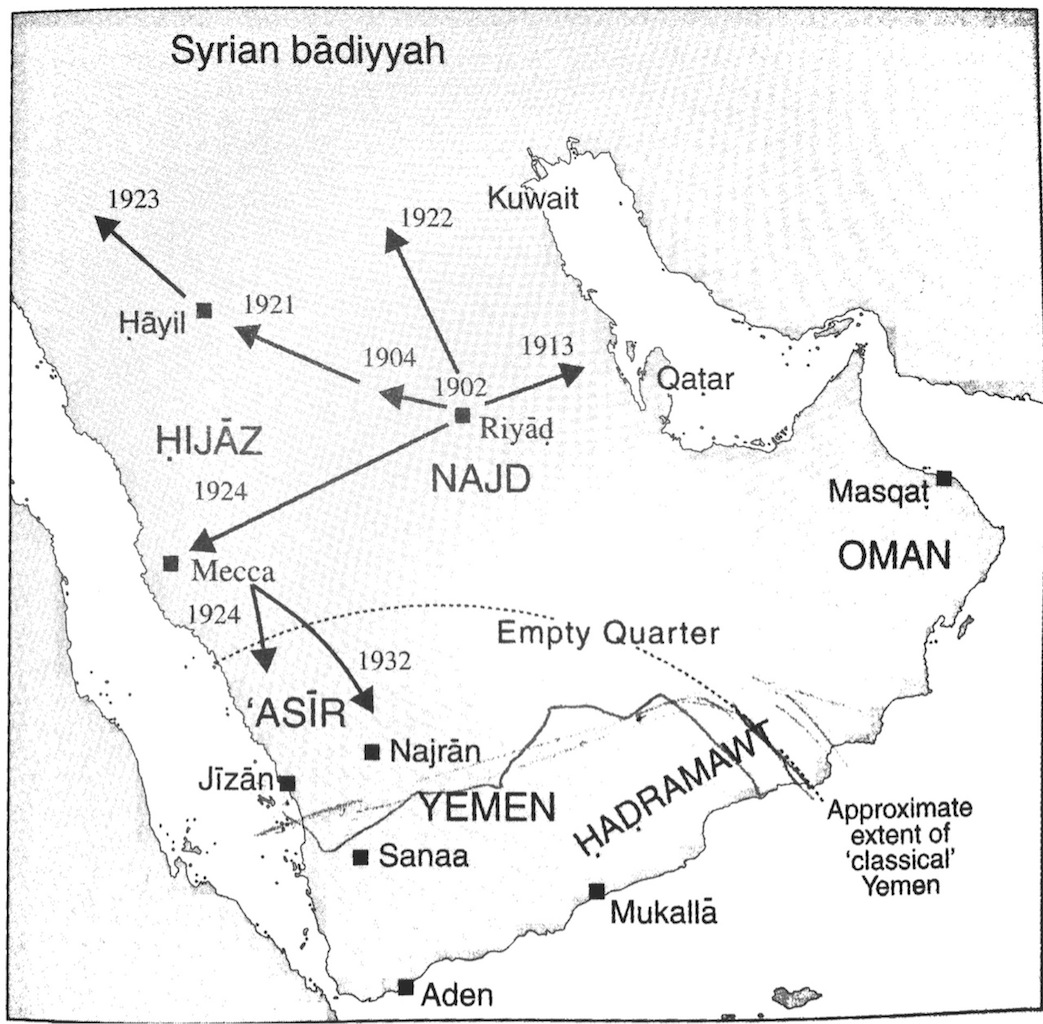
Source: Dresch, Paul. A History of Modern Yemen. Cambridge: Cambridge United Press, 2000. 33. Print.
Under the Imamate, formal education did not develop much and carried on according to how the Ottomans have left it (i.e. no ministry of education or formal unified curriculum). Regardless, some progress occurred in boys’ education where Dar Al-'Ulum (House of Science) and a public library was created in 1919, bearing in mind that the majority of students never completed middle school or high school. By 1949, The North of Yemen had a total of 535 schools; one of them for females (see chart 2 for the breakdown of schools). Girls in elite families went to al-mu’alaamah (a form of Islamic school) where they memorized the Qur’an for a few years and in 1949, a special school was founded to teach girls home economics and sewing (Ba’abad 51-67). Generally, schools were located in urban areas and were scarce in rural areas which required boys to make long commutes to classes (Noman 2). Of course, due to the conservative nature of the North, girls were not allowed to travel that far without constant male supervision.

The Imamate which ruled like an isolationist monarchy faced a lot of opposition and by 1962, the people of Yemen overthrew Imam Muhammed Al-Badr. While the south was inspired by Marx, the North was inspired by Egypt’s Nasser who promoted an ideology of Arab Nationalism. At the end, the revolutionaries proved stronger and the Yemen Arab Republic (YAR) was created (see map 4). By 1970, Saudi Arabia officially recognized the new government which put an end to the Imamate (‘Ali 47). When the YAR took control, education in the north was ghastly. According to data provided by the World Bank in 1965, only 9% of total number of primary school age group were enrolled, with 1% female (Boxberger 121).

This lack of concern for women, carried out to other aspects of Yemeni society. Although the new country created a nationalist constitution (similar to that of Egypt’s), it took time to formulate laws concerning women. Family contentions in the YAR were settled in different ways according to Islamic law or Shari’a of the region. Zaydi courts used ijtihad (interpretation by the personal effort of a scholar) which treated each case as unique. This granted more rights to women than in Shafi’i courts where a single interpretation of the law applied. Many times family and women matters would be settled according to ‘urf or tribal law which is based on ahkam al-aslaf or rules of the ancestors (Molyneux, “Women’s Rights and Political Agency” 420). It was not until 1979, when Saleh came to power, that the YAR developed a National Family Law that incorporated Zaydi and Shafi'i jurisprudence. Overall, the laws followed the conservative and religious nature of the North; polygamy (as long as the husband practiced 'adl or equity) and talaq were permitted. Marriage age, for males and females, was legally set at 15 years old; however, it was not enforced. At times, when a family matter did not seem to be explained in the law, the adjudication was in the hands of the qadis or judges (Molyneux, "Women's Rights and Political Agency 419-420). Women's rights in the YAR seemed to lag behind those of the south; for example, women in the North gained the right to vote in 1983 while women in the south earned that right in 1970 (Khalife 10). For the most part, the approach to laws concerning women was heterogeneous due to the lack of a strong central state and granting women education was determined by individual families.
Source: Dresch, Paul. A History of Modern Yemen. Cambridge: Cambridge United Press, 2000. 33. Print.
Under the Imamate, formal education did not develop much and carried on according to how the Ottomans have left it (i.e. no ministry of education or formal unified curriculum). Regardless, some progress occurred in boys’ education where Dar Al-'Ulum (House of Science) and a public library was created in 1919, bearing in mind that the majority of students never completed middle school or high school. By 1949, The North of Yemen had a total of 535 schools; one of them for females (see chart 2 for the breakdown of schools). Girls in elite families went to al-mu’alaamah (a form of Islamic school) where they memorized the Qur’an for a few years and in 1949, a special school was founded to teach girls home economics and sewing (Ba’abad 51-67). Generally, schools were located in urban areas and were scarce in rural areas which required boys to make long commutes to classes (Noman 2). Of course, due to the conservative nature of the North, girls were not allowed to travel that far without constant male supervision.
Chart 2: School Classifications in 1957

Source: Ba'abad, 'Ali. Al-Ta'aleem Fee Al-Jumhooriah Al Yamaniyah [Education in the Yemeni Republic]. 7th ed. Sana'a: Maktabat Al-Irshad, 2003. 68. Print.
The Imamate which ruled like an isolationist monarchy faced a lot of opposition and by 1962, the people of Yemen overthrew Imam Muhammed Al-Badr. While the south was inspired by Marx, the North was inspired by Egypt’s Nasser who promoted an ideology of Arab Nationalism. At the end, the revolutionaries proved stronger and the Yemen Arab Republic (YAR) was created (see map 4). By 1970, Saudi Arabia officially recognized the new government which put an end to the Imamate (‘Ali 47). When the YAR took control, education in the north was ghastly. According to data provided by the World Bank in 1965, only 9% of total number of primary school age group were enrolled, with 1% female (Boxberger 121).
Map 4: North Yemen: Provinces, Major Cities, and Major Roads, 1984 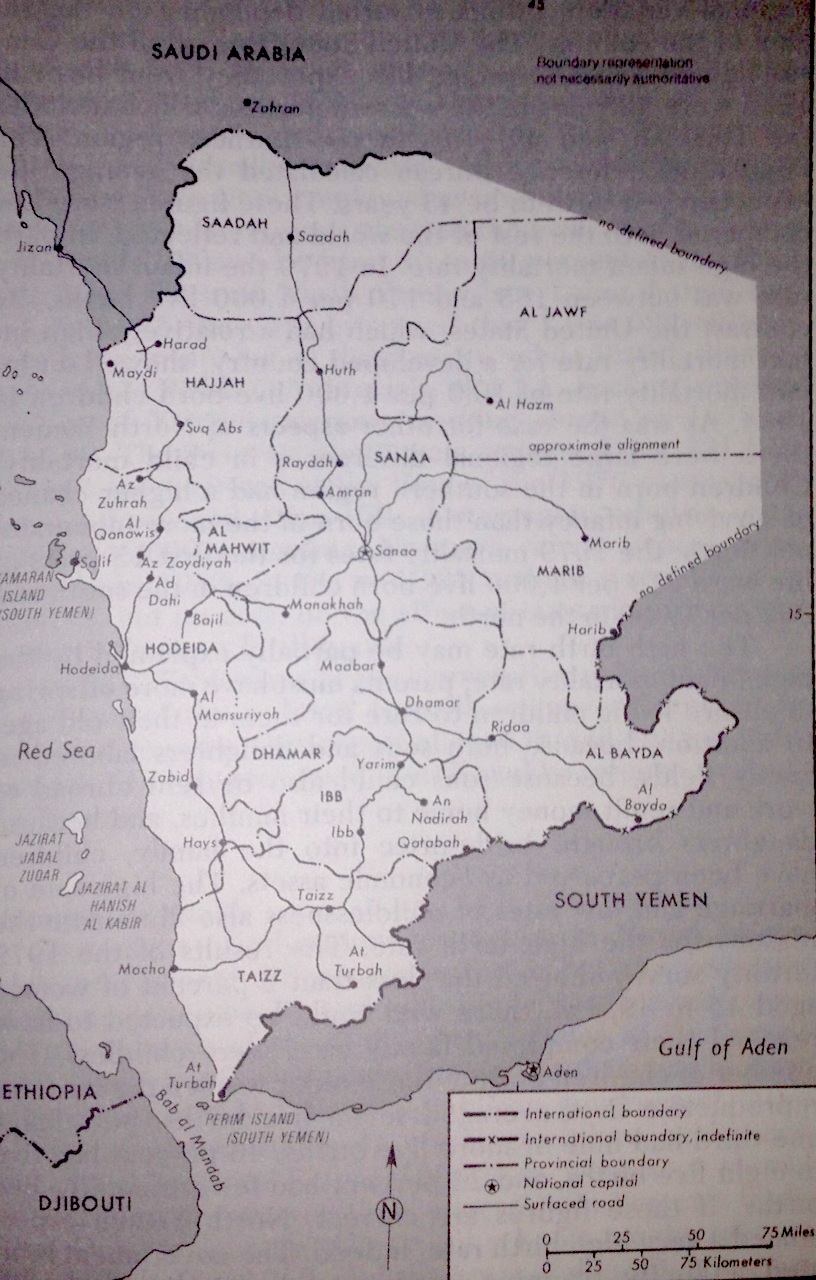
Source: Krieger, Laurie, Darrel Eglin, Sally Ann Baynard, Donald Seekins, and Bahman Bakhtiari. The Yemens: Country Studies. 2nd ed. Washington, D.C.: American University, Foreign Area Studies, 1986. 101. Print.
Female Education in the YAR
The first president of the YAR, Abdullah Al-Sallal, showed interest in improving female education, after all, the country witnessed minimal progress during the Imamate. During his inauguration ceremony in the city of Ta'izz, women were invited to participate in the celebration as an equal participant to men, which promised a better future under the YAR. The structure of the educational system was different than the PDRY; students had six years of primary education, three years of intermediate education, followed by three years of secondary education (Noman 2). Furthermore, the constitution of 1963 stated that education is a right for all Yemenis in article 32, and based on this, the Ministry of Education was created. The ministry created a system and a curriculum that emulated the educational system of Egypt. In turn, Egypt supplied the YAR with many educators to teach until the country had enough graduates to employ its own teachers. Many other countries lent a helping hand to Yemen; Saudi Arabia built schools, Kuwait paid the salaries of teachers, and Sudan sent employers to work as teachers (Boxberger 121). In 1969, a law was passed obligating university and higher education graduates of teaching in the country for two years prior to employment (Ba’abad 77-80). From 1963 to 1990, the YAR worked hard to improve education (see chart 3), but no specific sector was dedicated to women and only families that allowed their girls to go to school were educated.
Source: Krieger, Laurie, Darrel Eglin, Sally Ann Baynard, Donald Seekins, and Bahman Bakhtiari. The Yemens: Country Studies. 2nd ed. Washington, D.C.: American University, Foreign Area Studies, 1986. 101. Print.
Female Education in the YAR
The first president of the YAR, Abdullah Al-Sallal, showed interest in improving female education, after all, the country witnessed minimal progress during the Imamate. During his inauguration ceremony in the city of Ta'izz, women were invited to participate in the celebration as an equal participant to men, which promised a better future under the YAR. The structure of the educational system was different than the PDRY; students had six years of primary education, three years of intermediate education, followed by three years of secondary education (Noman 2). Furthermore, the constitution of 1963 stated that education is a right for all Yemenis in article 32, and based on this, the Ministry of Education was created. The ministry created a system and a curriculum that emulated the educational system of Egypt. In turn, Egypt supplied the YAR with many educators to teach until the country had enough graduates to employ its own teachers. Many other countries lent a helping hand to Yemen; Saudi Arabia built schools, Kuwait paid the salaries of teachers, and Sudan sent employers to work as teachers (Boxberger 121). In 1969, a law was passed obligating university and higher education graduates of teaching in the country for two years prior to employment (Ba’abad 77-80). From 1963 to 1990, the YAR worked hard to improve education (see chart 3), but no specific sector was dedicated to women and only families that allowed their girls to go to school were educated.
Chart 3: Improvements in Middle School education from 1962 to 1990

Source: Ba'abad, 'Ali. Al-Ta'aleem Fee Al-Jumhooriah Al Yamaniyah [Education in the Yemeni Republic]. 7th ed. Sana'a: Maktabat Al-Irshad, 2003. 87. Print.
This lack of concern for women, carried out to other aspects of Yemeni society. Although the new country created a nationalist constitution (similar to that of Egypt’s), it took time to formulate laws concerning women. Family contentions in the YAR were settled in different ways according to Islamic law or Shari’a of the region. Zaydi courts used ijtihad (interpretation by the personal effort of a scholar) which treated each case as unique. This granted more rights to women than in Shafi’i courts where a single interpretation of the law applied. Many times family and women matters would be settled according to ‘urf or tribal law which is based on ahkam al-aslaf or rules of the ancestors (Molyneux, “Women’s Rights and Political Agency” 420). It was not until 1979, when Saleh came to power, that the YAR developed a National Family Law that incorporated Zaydi and Shafi'i jurisprudence. Overall, the laws followed the conservative and religious nature of the North; polygamy (as long as the husband practiced 'adl or equity) and talaq were permitted. Marriage age, for males and females, was legally set at 15 years old; however, it was not enforced. At times, when a family matter did not seem to be explained in the law, the adjudication was in the hands of the qadis or judges (Molyneux, "Women's Rights and Political Agency 419-420). Women's rights in the YAR seemed to lag behind those of the south; for example, women in the North gained the right to vote in 1983 while women in the south earned that right in 1970 (Khalife 10). For the most part, the approach to laws concerning women was heterogeneous due to the lack of a strong central state and granting women education was determined by individual families.
Tomorrow: Women's education after 1990 in Yemen
Subscribe to:
Posts (Atom)