Sunday, April 14, 2013

Hadi’s Gamble: Yemen’s Military Restructuring and its Impact on the Future

My latest Op-Ed for The National

On April 10, Yemen's President Abdrabu Mansur Hadi boldly issued a decree to restructure the nation's military. The most notable achievements of this decree was dismantling former president Ali Abdullah Saleh's grip on the military by sending many of his relatives abroad as diplomats.

The decision reinforced Mr Hadi's previous military decrees to abolish the First Armoured Division led by Gen Ali Mohsen Al Ahmar, and the Republican Guard, led by Mr Saleh's eldest son, Ahmed. These two units stirred the most controversy.

Still, the decree is a major gamble by Mr Hadi, who is looking to ease the tensions that have paralysed Yemen for the past two years. This move is aimed to define the function of the new military, but it will likely increase tensions in the long run rather than solve them.

The military structure is made up of three different powers: From the north, Gen Mohsen, who defected from the former regime, was named the chief military adviser to the president. As such, he will have major influence on the military. Together with the Islah party the main opposition party in Yemen, they control almost half of the military.

Mr Hadi, who hails from the south, controls the second large portion of the country's forces. The last component of the military belongs to the remnants of Mr Saleh's regime.

Based on these divisions, it is apparent that the military wasn't able to shake off former tribal influences, which leads to the conclusion that three main struggles are likely to arise due to geographical and ideological differences.

First, the northern powers of Gen Mohsen and Islah could threaten the Houthis, who control a largely autonomous area on the border with Saudi Arabia. Second, the southern powers of Mr Hadi could try to curb Hirak's separatist influence in the south. But th real struggle will manifest within the military, between the components as they strive for power and dominance.

In the past decade, the Yemeni government has fought an on­again, off­again guerrilla war against the Houthis, a Shia revivalist group. All of the six wars were spearheaded by Gen Mohsen under Saleh's regime. But, once Mr Saleh agreed to step down in late 2011, the conflict took on more of a sectarian character, as the Houthis increasingly clashed with tribal and religious militias linked Islah. These two strands of anti­Houthi resistance are now coming together.

Gen Mohsen may have lost his armoured division, but he remains a key military figure in the new order. More importantly, two of hi allies have been named regional commanders in the areas bordering the Houthis' stronghold in the north. As expected, the Houthi have marched against Mr Hadi's military reshuffling, believing that their enemies are looking to surround them and destroy them.

The threat to the Houthis is highly dangerous, particularly since the Houthis tend to lash out whenever they feel cornered. 


In the south, the rest of the military will be occupied with a different conflict. The leadership of Hirak, the southern movement pushin for secession, has refused to join the National Dialogue which is now underway. Almost all of the south's leadership, including Mr Hadi himself, belonged at some point to Yemen's Socialist Party.

Today, these leaders are divided between those who support the president, and in turn unity, and those who do not. Personal vendettas and long-standing feuds still colour much of the interaction in the south.

Two scenarios are possible: First, as is the case in the past, mysterious assassinations could begin between these opposing forces. Or, the conflict could morph into several regional conflicts.

Ultimately, the lives of separatists will be in danger. The military will always support the home region of the president, Abyan, and Islahis will not hesitate to involve their militias and their hold on the military to gain control over southern territories.

Yet the most important struggle will be the one within the military itself. The two dominating powers of the military, Gen Mohsen and Islah on the one hand and Mr Hadi's forces on the other, could easily result in a typical north-south regional schism. But it could also take on a more ideological flavour between those aligned with Islah and those who oppose the conservative religious party. Islah is looking to rule and Mr Hadi, at some point, will have to seriously consider joining forces with them.

That leaves Mr Saleh's allies, the vulnerable component of the military, to seek new alliances outside of the military. It is likely that they will collaborate with the Houthis and Hirak.

The new military decree suggests that Mr Hadi is unlikely to step down in 2014, or even 2016 for that matter. Through the military, Mr Hadi is finally establishing his authority and if he leaves in the near future, the balance of power in Yemen will be skewed. Yemenis will continue to battle over political, ideological and regional influence.

The military restructuring doesn't solve Yemen's infighting. Rather, it could exacerbate it at a time when the country has more pressing issues. Within this military reshuffle are the seeds of years of future conflicts.

Friday, April 12, 2013

Military Restructuring in Yemen: Exploring Transformation

President Hadi's decree no. 16 for 2013 on military restructuring has been dubbed "historical" and "unprecedented". It was welcomed by most media outlets. On Yemen's ground, the news received mixed reviews: those who protest Saleh's immunity are upset that these appointments "reward criminals", while those who are skeptical of the transitional period are relieved to see many of Saleh's men transferred outside of the country. It is a chance for stability. Like Yemenis say, Le Kol Hadethen Hadeeth, For each occasion its own conversation.  So, in today's post, Yemeniaty examines the focal points of the new appointments and whether it is really historical. 

The New Military 

The previous chart reveals the new power distribution based on governorates/region. The regions colored in white didn't gain any influence. Conversations on military restructuring can prove confusing; however, one must remember these key points: 

1) Mohsen's First Armor Division and Saleh's Republican Guard are dissolved. 
2) Regional Military Commanders are independent from local military units. 
3) The Military reserve now follows the Ministry of Defense and no longer the President. 
4) Military divisons are now based on tasks and each have designated weapons (Yes, it was a mess!).
5) The Military will be composed of seven commands based on geographical divisions. However these commands will be labeled numerically rather than regionally. (Note Hadi's Southern Mentality: after independence from British Colonialism, Southerners referred to governorates by numbers rather than by their traditional names).

The seven regional divisions are as follows: Regional Division 1 (Sayoun), Regional Division 2 (Al-Mukalla), Regional Division 3 (Marib), Regional Division 4 (Aden), Regional Division 5 (Al- Hodaydah), Regional Division 6 ('Amran), and finally Regional Division 7 (Dhamar). 

The New Power Struggle 

The main distribution of military power reveals three key players. First, it is important to note that Saleh's power is not entirely gone as he did rule the country for 33 years.Thus, one of the key players is (what is left of) his regime. Out of the new seven military commands, Saleh's allies still have two.

The two other key players are relatively new: in the North there is Ali Mohsen and Al-Islah and in the South there is Hadi. 
In the North, Ali Mohsen came out on top while Al-Ahmar's family, still belonging to Islah, did not really get what they want. Colonel Hashem Al-Ahmar was sent away as part of Saleh's men to Saudi Arabia to hold the position of Defense Attaché. Carefully, Islah is strengthening its relationship with Ali Mohsen. Under Mohsen's direct influence are Major General Al-Sawmali, First Regional Military Commander (Region Sayoun), Major General Al-Maqdashi, Sixth Regional Military Commander (Region 'Amran), and Brigadier General Shamiri, Commander of the 27th Mechanized Brigade. Islah's most influence is on Brigadier General Muthana, Seventh Regional Military Commander (Region Dhamar). The combined Northern powers control almost half of the seven military commands. 

As for the South, Hadi distributed a generous amount of positions for people who were once members of the former YSP. Recalling Al-Toghmah and Al-Zomrah YSP divisons, one might be pleasantly surprised to know that Hadi, a Zomrah himself, appointed 13 Al-Toghmah members. Some might, wrongfully, consider it a peace offering to the Southern Hirak. Unfortunately, this is not the case. Those specific Toghmah individuals abandoned their former allies and are now loyal to Hadi. Furthermore, all of the Toghmah individuals were secondary commanders to begin with. 

Not to mention that Hadi is using a familiar tactic. Saleh previously appointed people from his town/village in important positions and now Hadi is following suit. Take Major General Mhanaf, the new Chief of the Intelligence Bureau; he replaced the Southern Al-Yafi'i, mainly because Mhanaf is from the same part of Abbyan as Hadi. Not to mention that the New Minister of Defense, Brigadier General Hujairi, and the Assistant Secretary of Denfense for Human Resources, Major General Ben Fareed, are all Hadi's men. Assertively, Hadi positioned his authority as the new kid on the block. The new military is in the hands of Mohsen and Islah in the North and Hadi in the South. 

Farewell Saleh? 

Every time we begin to forget former President Saleh's name, a news article here or there reminds us of his presence. Whether is it news over his health, an opening of a "Saleh museum", or delivering a speech about freedom, he somehow reappears. Saleh would have been forgotten a lot quicker if it wasn't for his carefully formulated central authority. He spent years positioning those who are near and dear to him in powerful positions.  Just when Yemenis were giving up hope, President Hadi decided to play scramble with his men. Hadi, diplomatically, gave them ambassadorial and consular positions. 

In a twist of fate, this move, applied on Saleh's allies, was utilized by Saleh himself. For years, he sent individuals inconvenient to his authority into the foreign service program. For instance he sent  the three following men to Washington DC as Ambassadors: Yehya Al-Mutawakkil, Mohammed Al-Eryani and Mohsen Al-'Aini. Now, it is Hadi's time. 

Hadi began with Ahmed Ali Saleh, previously expected to inherit Yemen's presidency. Saleh the son will settle for the position of Ambassador in the United Arab Emirates. There, he can join other members of his family who settled in Abu Dhabi over the past two years. He is guaranteed to live in luxury and to relax for the rest of his diplomatic career.  As for the rest of Saleh's family and allies, they were appointed as Defense Attachés to the following countries: Qatar, Egypt, Germany, Kingdom of Saudi Arabia and Ethiopia. 

The Rise of Ali Mohsen

Major General Ali Mohsen is from the same city as Saleh, Sanhan. Ali Mohsen served as Saleh's right hand man for decades as the president's Chief Military Advisor. Some called him "the second most powerful man in Yemen" and others who knew him more closely called him "the most powerful man in Yemen". In December of 2012, some thought that Mohsen's glory was coming to an end since his First Armoured Division was terminated. However, in April 2013, and according to Hadi's decree, Mohsen is once more a presidential Military Advisor. 

The rise of Ali Mohsen was expected, and in fact slower than anticipated. Ali Mohsen's defection in March of 2011 from Saleh was the catalyst that encouraged 
those who were loyal to the former president to oppose him publicly. Mohsen abandoned his life long friend after rumored disagreements on Ahmed Ali Saleh's (Saleh's oldest son) growing influence in Yemen. In this power struggle, Mohsen came out on top. Shortly after Mohsen declaration of "supporting and protecting the revolutionaries" Islah welcomed Mohsen as a freedom fighter, forgiving all his past sins. On the other hand, independent revolutionaries considered his role in the revolution as a clear indication that Yemen's revolution was hijacked and doomed. Realistically, it would be near impossible to dispose of Mohsen. His influence couldn't be shaken and now he is part of the new system. So today, we have the "March 21st Garden" in Mathbah (Sana'a) as a park for Yemenis in place of Mohsen's former First Armor Division. 

Wednesday, April 3, 2013

Female Agency in the Yemeni Transition


This is published in the International Training Programme for Conflict Management (ITPCM) and can be found online here.


For the first time since unity in 1990, Yemeni women are challenging tradition. Breaking curfews, participating in political activities after nightfall, reciting folkloric poetry and shouting revolutionary slogans became common during and after the Revolution. For women, the Revolution was truly exceptional. They participated in sit-ins and addressed mixed crowds. The decoration of Nobel Peace Prize Laureate Tawakkul Karman underscored the activism of Yemeni women around the world. Yemeni women were featured in numerous magazines, websites and newspapers as champions of civil society. During the uprising, women were equally as influential as men. In essence, women initiated a revolution within a revolution. The presence of Arab women in the public sphere during the Arab Spring misled many observers to believe that a women’s right movement was underway. Others were skeptical, warning that once political regimes began to collapse, the status quo would be restored. Only a few bothered to ask: what do women want from their Revolution? Yemeni women cannot uniformly answer this question because their experiences are not monolithic. The political dichotomy of the North and South produced alternate realities for women, especially as the North is more conservative and tribal than the South. After the unity in 1990, these realities continued to change based on the location, affluence and heritage of a woman’s family. Coupled with Yemen’s patriarchal and conservative culture, it was difficult to establish a unanimous movement for women. The current transitional government has three women Ministers out of 35. The Technical Preparatory Committee (TPC)[1] for the National Dialogue was composed of 19% women. One female out of 301 members is a parliamentarian and two women are members of the Shura Council. These political positions, none of which are decision-making, give the impression that women in Yemen have a greater role in the executive branch. The term “feminism” in itself remains controversial, and gender issues must be handled with care. In a system that is discriminatory in its legislation[2] against women, “feminist” objectives can be sidelined. Since women’s freedoms were restricted after Saleh’s fall, it became apparent that some of the women who participated in the uprisings were merely pawns for opposition parties. Despite these setbacks, there have been minor improvements to women’s political participation. On March 18, the National Dialogue began, leaving the fate of Yemen’s entire female population in the hands of a few women from various political backgrounds. Their goal is to simultaneously advocate on behalf of their parties and organizations, as well as women more broadly. As of now, existing accommodations made for women are insufficient, making it difficult for the National Dialogue to facilitate gender equality. Women must lobby for their rights outside of politics, and approach the problem from a different perspective to see results. As Feminists or as Politicians at the National Dialogue?
Current president, Abd Rabbuh Mansour Hadi, made a point of advocating a 30% female quota in the National Dialogue. The conference will separate members into nine working committees.[3] Members have submitted their committee choice to the President[4] of the dialogue and his six deputies, none of which are women. Soon, these committees will begin their deliberations. Even though women’s issues deserve broader representation across the board, the topic will be examined under the eighth committee, “Rights and Freedoms”. Constitutional reform will be discussed in a separate committee, “Good Governance”. The structure of the dialogue does not support wholesale changes to the status of women’s rights, and it is not evident that discussion of women’s issues will make it into questions concerning constitutional reform. The status of women and their inability to affect change through the Dialogue are exacerbated by two problems. First, some of the women selected to participate are at a crossroads: are they feminists or politicians first? Are they representatives of their party or of women? Yemen’s “democratic” transition has played out as an exclusively political process through which women are incentivized to champion ideas that oppress other women. Unified by gender but divided by politics, women in the National Dialogue will frame gender issues like women’s security, economic poverty and illiteracy as political issues. Based on political divisions, the methodology of dealing with these topics will vary. Religious parties like Islah, Ansar Allah (Zaydi), Al-Haq (Zaydi and Hanafi) and Al-Rashad (Salafi) would approach women’s issues from a Shar’iah perspective, but ideological differences are likely to cause disagreements. Socialist groups, independents and even Ba’thist will advocate non-religious reforms or a mixture of both. A single group of unified women is much more powerful than smaller groups of women that are at odds. These political issues will polarize the women’s agenda and make it susceptible to the principle of divide and rule. Second, the same tactics used to question the legitimacy of the dialogue can be used to challenge solutions proposed to promote women’s rights. Any “feminist” agenda could be quickly dismissed as part of a Western conspiracy, since the dialogue itself is viewed as a foreign initiative rather than the result of a grassroots national process. Like several Arab Spring nations, Yemen is witnessing a rise in Islamic fundamentalism. Four religious parties will participate in the dialogue, and since Islah gained more influence beginning in 1994, female judges were dismissed as “incompetent in Islamic Law” and public schools were gender segregated after the sixth grade.[5] A narrow implementation of Islamic Shari’ah is expected. In Yemen, female equality is argued as a social liberalization process antithetical to religion, which could guarantee its failure. In Yemen’s conservative culture, religion dominates politics. The prevalence of early marriages in Yemen provides a revealing case. When Islah gained influence in Saleh’s government, the marriage age of 15 was abolished[6]. Since 2007, several governmental and non-governmental campaigns were launched in hopes of mandating a marriage age, but none of them succeeded. Radical interpretations of Islam were used to manipulate and limit the scope of female self-determination. The problem of child marriages still persists. According to Amal Basha, the spokesperson of the TPC, it has been a struggle to add the issue of underage marriage to the agenda of the National Dialogue. Eventually, TPC members “unanimously agreed to give it social priority.” Addressing child marriages, again, as a social issue with the same political actors makes it hard to fathom how social transformation can emerge through the National Dialogue. If previous methods proved futile, Yemeni women need to seek alternatives. Gender Strategies Outside the Social Realm
To improve women’s conditions, women need to frame their arguments outside of politics. A strategy that separates women’s issues from traditional values could prove successful in Yemen. Currently, 54% of Yemeni women are married before they reach the age of 18.[7] By tackling the “side effects” of child marriages, Yemenis can limit its social prominence without causing an overwhelming social backlash. About 58% of Yemeni women are illiterate.[8] Educational policies put in place by the government can assure that more girls are going to school. In Yemen, marriage means being a full-time homemaker, and if more girls are going to school, then they are less likely to marry or having children at a young age. Other strategies can tackle the same problem. Innovative health policies can produce substantial changes in reducing the high maternal and infant mortality rates.[9] Poverty alleviation programs are another method through which women can lobby for reform. Since 44% of the Yemeni population is acutely malnourished[10], financial incentives can promote the use of contraceptives[11] to control population growth and address food scarcity. It is unlikely that women’s issues will receive special attention, since Hadi’s administration has been preoccupied with more pressing issues like security and military reforms. With soaring inflation and an unemployment rate at 42.5%[12], the nation is facing several challenges. Therefore, women need to address their needs by mobilizing collectively. Between Sa’dah’s six wars and Al-Qaeda’s occupation of Abyan, 50% of Yemen’s Internally Displaced Persons (IDPs) are between 5-17 years old[13]. Only a quarter of IDPs from all age groups return to their homes[14]. These challenges impose damage on the female body. Displacement can also lead to rape, gender violence, human trafficking, and prostitution. Women as a group need to realize that protecting their gender is feasible through security programs. Another collective concern is the deteriorating economy. In March, Friends of Yemen pledged around 7.5 billion dollars[15] in assistance to Yemen. While the majority of the money is allocated to development programs, the government must assign a portion of it to specifically empower female entrepreneurship Without change, the nation will continue to be the lowest ranked country in the world in gender equality. Increasing female participation in the labour market can decrease harmful social traditions. Using women as agents of economic reform can result in the creation of a new workforce that facilitates the self-determination of women. Conclusions
The national dialogue promoted the inclusion of women in the transitional process, but this inclusion does not guarantee a transformation of reality in Yemen. Previous tactics, like addressing women’s issues as social concerns, could lead to political manipulation. Also, these measures have been proven ineffective. The dialogue is still in its infancy. Until a clearer picture of the Dialogue’s trajectory emerges, women will not be able to formulate a viable strategy. The National Dialogue is attempting to address numerous concerns at once, while struggling to maintain unity and reform a corrupt political system. For the time being, women need to advocate through each of the nine working committees. The female members of the dialogue are responsible for tackling women’s issues strategically from every possible front, because the obstacles facing them are not independent of each other, but are closely related and must be treated as such. To restrict the harmful consequences of tradition, non-social solutions should be considered. For instance, increasing female participation in educational programs, health programs and in workforce can alleviate problems such as child marriage. If more girls are going to schools then less of them are available for marriage. Affordable and accessible health care can reduce early deaths amongst young mothers and infants. Economic opportunities for women can provide families with additional income. While it is challenging to demand equality in a conservative culture, it is reasonable to demand equal access to health, education and economic opportunities. For the full emancipation of women, Yemen’s constitution must clearly delineate women’s rights, otherwise laws will continue to sanction the oppression of women. Women in the dialogue need new methods and must remain cautious of political ploys. Gender equality is difficult to achieve, but it will only become possible once we are aware of alternative options.


________________ [1] A 31-member Committee commissioned by President Hadi to decide on the size of participants, the rules for eligibility and for the mechanisms used during the dialogue. [2] Laws do not dictate but rather permit discrimination. For example, the Personal Status Law on wife’s obedience sanctions marital rape and restricts women’s freedom of movement. [3] Committees are divided based on Issues: Southern Issue, Sa’dah Issue, National Issues, State-building, Good Governance, Military & Security building, Independent Agencies, Rights & Freedoms, and Comprehensive Development. [4] President of the Dialogue is President Hadi. [5] Molyneux, Maxine, “Women’s Rights and Political Contingency: The Case of Yemen, 1990-1994.” Middle East Journal 49.3 (1995): 418-31. [6] Khalife, Nadya, How Come You Allow Little Girls to Get Married?: Child Marriages in Yemen. New York, NY: Human Rights Watch, 2011. [7] “Yemen: A Wake Up Call to Early Marriage.” Oxfam International Blogs. Oxfam, 30 August 2012, retrieved on-line 15 March 2013. [8] According to World Bank Indicators, 2010. [9] “Yemen: A Wake Up Call to Early Marriage.” Oxfam International Blogs. Oxfam, 30 August 2012, retrieved on-line 15 March 2013. [10] Burki, Talha, “Yemen’s Hunger Crisis.” The Lancet 380.9842 (2012): 637-38. [11] Only 9.3% of Yemen’s population uses a modern form of contraception. USAID Country Health Statistical Report, Rep. Washington DC: Bureau of Global Health, 2009. [12] The Second National Millenium Development Goals Report. Sana’a: United Nations Development Fund and the Republic of Yemen, 2010. [13] The Republic of Yemen. Operational Unit for IDPs Camps. Information Center.Summary Showing the Number of Households by the Orginal District and Governorates. Sana’a: ROY, 2013. [14] Ibid. [15] Andersen, Inger. “Friends of Yemen: World Bank Vice President Inger Andersen Urges Support for Yemen’s Transition.” Friends of Yemen: World Bank Vice President Inger Andersen Urges Support for Yemen’s Transition, The World Bank, 7 March 2013 retrieved on-line 14 March 2013.

Saturday, March 30, 2013

Yemen's National Dialogue Working Committee: Visual Learners Edition

(Reproduction of the following charts is permitted as long as they sourced to Yemeniaty)

On March 30th, Yemen's National Dialogue website released the names of the members participating in the nine working groups. The nine working committees will discuss the following topics: 

1) Southern Issue 
2) Sa'dah Issue 
3) Good Governance 
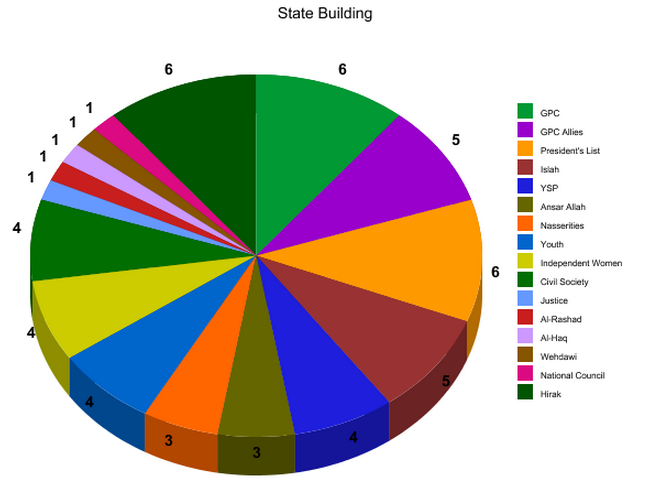
4) State building 
5) National Reconciliation
6) Development
7) Rights and Freedoms 
8) Army and Security  
9) Independent/Social Issues

Although it seems like the final list will need revisions since several lists appeared online and were circulated amongst Yemenis with different numbers of participants. So far 11 members withdrew from the dialogue: 

- One independent: Ahmed Saif Hashed 
- Three from Islah: (1) Mohsin Ba'Sorah, (2) Tawakkol Karman and (3)Sheikh Hameed Al Ahmar 
- Seven from Hirak: (1) Ismahan Al-'Alas,  (2) Saleh Taher Al-Isa'ey, (3) Abdulaziz Abdul Hameed Al Maflihi, (4) Sheikh Tarek Al Mohami, (5) Mahmoud Shaief Hussein, (6) Mustafa Zain Al-'Aidaroos and (7) Khaled Ba-Ras. 


The total number of participant should be 554; however, after several revisions to different lists the following charts are based on a 555 member conference. 

Here are the groups: 


In this committee, Hirak members have the biggest share. Followed by GPC, then YSP and Islah. 

This category is dominated by GPC, then Hirak then members from the President's list. This category is where child marriages and other women issues will be discussed and it has 36 women and 45 men. 

This is another group where Hirak, GPC and the members from the President's list have the most representation. 

Civil Society is represented better in this category than most of the other working Committees. 


Like the Southern Issue Committee, this group is represented by people who are affected most by it: Ansar Allah (formerly referred to as Al-Houthis). However in comparison, they are less represented since the committee is composed of 48 members (Southern Issue 40) and only 10 are from Ansar Allah. Also, Hirak has equal members to the GPC (6 seats), while Ansar Allah had only 2 seats in the Southern Issues Committee. 

This group will be looking at constitutional reform. Half of the members in this group are from Civil Society, GPC, GPC's Allies, Islah and the President's list. Possibly the least group with Hirak representation. 
The Army and Security is a surprisingly fair to the South in that Hirak has as many seats as GPC. Unfortunately this balanced is tipped off when GPC gave its allies 5 seats. The real losers in this category are women (4/45)
The main topic in the Good Governance Committee is Civil service reform. It seems to be a fair representation of the members chosen for the dialoge. 

Like expected, women are represented fairly in the development, independent/social issues, human rights and freedom, and national reconciliation group. Women are less likely to be present in serious issues like security and military, Southern and Sa'dah Issue. 


The final list of members in the Southern Issue is challenged by the Southern Hirak and the final list will be issued tomorrow. All these representations are susceptible to change.   

Tuesday, March 26, 2013

US Policy towards Yemen: An interview with Danya Greenfield


Today in DC, an event orchestrated by the Atlantic Council and the Project on Middle East Democracy (POMED) took place discussing US foreign policy towards Yemen. During the discussion, the three speakers (Greenfield, Heyedmann and Al-Bukari) talked about the nature of US and Yemeni attitudes towards each other. Although one would assume that these opinions are public knowledge, it felt as if a big secret was finally out.  It was amongst the few (if not the first) big Washington DC-event that directly pointed out that some of the US's policies towards Yemen were "counterproductive". The event, which included the President of the Polling Center, Hafez Al Bukari, brought a lot of awareness to Americans. Danya Greenfield and Stephen McInerney (Executive Directer of POMED) collected 31 signatures to advise Obama's administration of reassessing US policy towards Yemen (emphasizing the excessive use of Drones).

I met with Danya Greenfield for the first time about two months ago and I was pleased to observe her in her element. For an established woman (she is currently the Deputy Director of the Rafik Hariri Center at the Atlantic Council), she was humble and formed her opinions carefully after doing a lot of research. She did one thing that most people in her position don't: she listened.

A month ago, I sat down with Ms. Greenfield and we talked about the relationship between the US and Yemen. Here is what she had to say:


You can find the letter to President Obama here.

Although it is common knowledge amongst Yemenis that the use of drones is not well liked, this event reveals (publicly) that there is hope for US foreign policy in Yemen. Events like this should make us aware that not all American programs in Yemen "support the use of drones".

The event highlighted how Yemeni and American officials are not having transparent exchanges with each other. Meaning that neither side had an honest discussion about how the average Yemeni is unhappy with the US' counterterrorism policies.

My own analysis is that this is frustrating to both sides. It actually creates a problem that is hard to resolve. Yemenis tell Americans what they want to hear so they can be backed up. Americans never know the real truth and support them without doing their own in-depth research. The problem gets worse when the US begins to analyze the results and put the pieces together. They have many choices but will either choose one of the two: to continue pretending that nothing is wrong or to completely stop their support of whomever they are backing up. If the US continues its support, then they look bad, but if they decrease their support, then the Yemenis on the ground will be left in an awkward position.


Sunday, March 24, 2013

Secession for South Yemen would Lead to Catastrophe

Article Published in The National, you can read it here.


Yemen's "national dialogue" finally began one week ago today, after several deferrals. The agenda is dominated by the "southern issue", the question of southern secession.

The Southern Movement, commonly referred to as Hirak, is already expressing its dissatisfaction with the dialogue. Hirak has 85 seats in the dialogue assembly, but several factions within the movement said in a joint statement on March 21 that those 85 representatives do not properly delineate Hirak's demands.

Any scenario other than full Hirak participation in the talks will threaten the nation's security and will ultimately cost many Yemenis their lives. The national dialogue will be squandered if Hirak's entire leadership is not on board.

Last month alone the government reported four deaths due to clashes between the Hirak and local authorities in the South.

On February 23 the president, Abd Rabbuh Mansour Hadi - originally from Dhakeen, a southern village - made his first visit to Aden, to acknowledge Hirak's grievances.

After the 1994 civil war, former president Ali Abdullah Saleh consistently overlooked the concerns of the South, as a form of revenge. There was talk of secession even then, and the movement gained momentum from 2007 to 2011, but was never unified enough to pose a real threat to Yemen's unity.

But now Hirak's fragmented leadership is a problem for national unity: if the factions cannot speak and act together, the dialogue will dissolve and chaos will follow.

Secession would not provide Hirak's divided factions with the independence they seek; rather, it would result in the creation of several weak regional regimes, in constant conflict with each other.

Yemen's government should have addressed legitimate southern concerns long ago. Now the issue will not be settled easily or quickly.

The present weak agreement among Hirak factions is the product of an interim alliance. The only thing uniting all of them is their common goal of secession, and their common enemy, the central government. Hirak members consider the South to be under occupation.

The southern proverb "he removes an onion, and grows garlic" refers to an apparent change that actually yields the same results. Southern power struggles have persisted through deceptive leadership changes, and this pattern is a good indicator of what the future would hold after secession.

The South has been divided since the days of the British occupation, which saw power struggles in Hadhramout, Abyan and Lahj. These internal rivalries continued after independence in 1967.

Over the next two decades, the South, as its own state, cycled through six presidents. Some transfers were peaceful while others were bloody, but all of them, while disguised as ideological or political, were driven by tribal politics and personal ambition.

In June 1969, a peaceful coup led to the removal of military leaders but also changed the regional balance of high-office-holders. And in January 1986, when internal "ideological" divisions occurred within Yemen's Socialist Party (YSP), several regions associated with the losing faction suffered losses; other regions gained influence based on their tribal loyalties.

These divisions still exist. Most current Hirak leaders were members of the YSP in the old southern People's Democratic Republic of Yemen. For these men the YSP served as a vehicle to power, and now Hirak does the same thing.

Personal conflicts still boil under the surface, damaging Hirak's leadership. No one in Hirak is capable of producing a transitional plan that can win wide support.

If secession occurs and the northern government is out of the way, a few southern leaders would opt for the creation of smaller political units, rather than consolidating the South.

Individuals such as the southern Islamist leader Tariq Al Fadhli would hope to restore their former reigns. For them, secession would be a golden opportunity.

Some within Hirak openly yearn for a return to "the old days", while others are still speaking in vague terms.

It is only a matter of time before individuals from powerful families claim authority based on their genealogy, especially if they manage to secede.

Beyond the old sultanates, there are some who would prefer a tribal emirate, another form of dynasty. And in the past few years, political Islam has gained momentum. Those who identify the most with their religious ideology are likely to demand the creation of Islamic caliphates or strict implementation of Islamic Shariah.

With a central government out of the picture, AQAP and Ansar Al Shariah could grip parts of the South.

The southern population is culturally diverse. New villages have sprung up, and older ones have expanded. Distinct identities do not exist anymore. But there are many who want distinct areas to control.

Taken together, all this means that after secession the South would have several inefficient micro-states, some of them strongly divided by prejudice and class distinctions.

Mr Hadi's government may still convince the remainder of southern Hirak to join the dialogue. Given the flexible nature of the talks, more seats can be assigned to other Hirak factions. But at the same time all elements of Hirak must consider their options and participate in the dialogue if they truly seek genuine "liberation".

For the South's sake, Hirak must submit to the dialogue and reach a settlement. The idea that secession will solve the South's problems is nothing but an illusion maintained by a few who seek power for themselves.

Secession would bring catastrophe. Participating in the national dialogue guarantees nothing, but it is the best alternative.


Follow the National @TheNationalUAE on Twitter 

Thursday, March 21, 2013

Pictures from My Country: Yemen's Currency

During my last trip to Yemen in August 2012, I went with my cousin to a restaurant. I bought juice and told her that it's my treat. I opened my wallet and I took out two 200 Yemeni Rials (currency code YER) to pay. To my surprise my cousin bursted out laughing telling me that I may be the only person in Sana'a who still carries that currency. She may be right. I held on to my money since the last time I was in Yemen in 2009 and things have changed.

In this blog post, I go over the history of Yemen's currency since 1990. 

Prior to 1990, the People's Democratic Republic of Yemen (South of Yemen) used the Dinar instead of the Rial. A single Dinar was the equivalent of one British pound which was made up of 20 Shillings. Below is the currency that the South used including an image of the 50 fils coin.


Image via ATSnotes.com


Coin from Wikimedia.org


Adeni Dinar (wikimedia.org)

Once unification occurred, one Dinar corresponded to 25 Rials. Even after unity, it was possible to see Dinars floating around in Yemen; however, they were officially terminated in June of 1996. Overall, a unified Yemen used the Rial (which is made up of 100 fils). 

In the North of Yemen, around 1970, the government issued coins for 1, 5, 10, 25 & 50 fils. These coins were terminated by 1990 (especially since their value weakened). 

Terminations continued well after unity. In 1993, the 1 and 5 rials coins were sacrificed even though they existed in paper form as well. 
Image from CoinGallery.com
                             

1 and 5 rials notes from here
Other monetary units existed in both, coins and paper form. For example 10 Rials used to be a coin, however by 1995, the Central Bank decided to produce it as a bill. The 20 Rials suffered the opposite fate, it was typically in paper form till 2004 when it became a coin. 


10 Rial Coin from CoinGallery.com
10 Rial from Bank Notes
20 Rial from Coingallery.com
20 rials from Here
Besides coins, there are different bills for the 50 and 100 Rials ever since inauguration of Yemen's unity. In 1996, the Central bank released the 200 YER bill, then in 1997 the 500 YER bill. Following that, in 1998, the 1000 YER bill made its debut. Finally, in 2009, a 250 YER bill came out which made the 200 YER bill impossible to find. Since I wasn't living in Yemen, it was easy to spot me as a visitor since I was using the 200 YER bill instead of the 250. 


Well, there goes the 101 on Yemeni Currency. If you like this topic there is a book called "Currency of Yemen through the Ages: 2008 A.D - 1424 A.H" produced by Yemen's Central Bank. It has the biggest collections of Yemen's currency and represents the first effort by Yemen's government of sorting and cataloging its currency. Every once in a while, it is available on Amazon. 
UA-42312960-1